NAfME BLOG
Adjudication—What’s the Point?

Adjudication—What’s the Point?
By NAfME Member Lori Schwartz Reichl
“Responsibility has become the fundamental imperative in modern civilization, and it should be an unavoidable criterion to assess and evaluate human actions, including, in a special way, development activities.”—Hans Jonas
This article and the accompanying MAKING KEY CHANGES podcast episode take me back to my roots as a music educator—but the message goes far beyond music. It speaks to how we lead, how we evaluate, and how we help others grow. March is Music In Our Schools Month®, and with it comes adjudication season—a time when ensembles are evaluated and judged. It can be rewarding. It can be stressful. But somewhere along the way, we may have forgotten the point of adjudication.
Time Away Doesn’t Diminish Knowledge
It’s been ten years since I left my full-time band directing career—one I thoroughly enjoyed for 15 consecutive years. But I never left music.
Over the last decade, I’ve maintained a private studio, guest conducted honor bands, adjudicated extensively, taught graduate courses to music educators across the country, and spoken or written regularly through monthly articles and a weekly newsletter and podcast. I’ve also served as a keynote speaker and earned a doctorate in music education.
I don’t share this to toot my own horn. I share it because I chose a different path—and through that path, I’ve gained a broader perspective.
I’ve also had the freedom to voice my opinions without fear of repercussion. I’ve continued to advocate for music education by speaking to legislators and board members, coaching educators, and supporting my own children’s musical journeys.
Yet I still hear, “But you haven’t been in the classroom lately.”
I used to respond: “Maybe not my own—but I’ve been in many.”
Then comes the follow-up response: “But things have changed.”
Maybe they have. But I’ve learned to let people think what they want.
My father hasn’t been a public-school band director in 25 years, and yet he’s still one of the first people I turn to when I have a question—because his perspective is invaluable. Time away doesn’t diminish knowledge. If anything, it sharpens it, allowing us to see more clearly what truly matters.
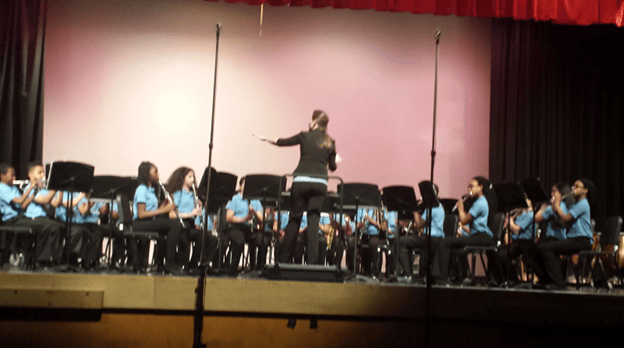
Conducting one of her former bands (2015). Photo courtesy of Lori Schwartz Reichl.
A Process Filled with Confidence and Compassion
When I was in the classroom, I’ll admit it—at times, I gossiped, I complained, and I blamed—especially during adjudication season. Time away has shown me the danger in that mindset.
When I was in my early thirties, I was first hired to serve as an adjudicator for a music ensemble festival. I was thrilled. It was a three-day event. After the first day, I was asked if I wanted an audio recording of my verbal comments. I listened on the drive home. I was disappointed. My voice was too soft. The pitch of my voice was too high. And most importantly—I offered very little that was helpful. My feedback focused almost entirely on what ensembles were not doing well.
I remember thinking: Would I want to hear this if this were my group? Would I share this with my students? These questions changed everything in how I approached the role of adjudicator.
It took time to find my voice—in many lanes—speaker, writer, and adjudicator. It took time to trust my own ears rather than be influenced by others. And it took becoming a parent to fully understand the weight of this experience—not just for students, but for directors—for people. Because adjudication isn’t just evaluation—it’s impact.
“Adjudication isn’t just evaluation—it’s impact.”
I would never want my students—or my own children—to leave a performance experience only hearing what they lacked. Or to receive a rating without clear, supported reasoning. Or to feel like one mistake defined their entire performance. I want them to learn. I want them to grow. But most importantly, I want them to feel confident and comfortable in the adjudication process—so they will return.
So when I hear adjudications described as a “bloodbath”—where comments are harsh, unclear, or overwhelmingly negative—my heart sinks. What are we teaching? What are we modeling? When adjudication panels lack representation, we have to ask why. When directors criticize the process without meaningful explanation, credibility erodes. And when adjudicators are texting during the process or sharing thoughts after—about scores, ensembles, directors, or even fellow adjudicators—we should question whether they deserve that responsibility at all.
The Necessity for Meaning and Understanding
So, I come back to the question: What is the point of adjudication?
If it is to rank, sort, and label, then we are missing it. If it is to tear down rather than build up, then we are failing. But if the point is to educate, guide, affirm, challenge with purpose, and inspire the next step in growth, then adjudication becomes something powerful—something meaningful, something necessary.
I have begun turning down opportunities to adjudicate performance events when the day exceeds a certain number of hours. I know my limit. For about six hours, I can remain fully present and engaged. Beyond that, fatigue sets in—my focus slips, and the quality of my feedback declines. And that’s not fair to students. I’ve sat on panels when days have gone as long as 11 hours. At that point, the danger isn’t just exhaustion—it’s diminished judgment, reduced clarity, and feedback that no longer reflects the standard students deserve. If a day extends beyond that, I would rather serve as a sightreading adjudicator or clinician—roles that allow me to move, interact, and engage directly with students—or not adjudicate at all.
The adjudicator role is not a badge of honor because we were invited. It is an honor because we were trusted.
I’ve heard the idea of placing the “less experienced” adjudicator in the sightreading room. I couldn’t disagree more. That role matters just as much—sometimes more. In that sightreading moment, we meet students immediately after they’ve performed—whether it went well or not. But we can assume one thing: They gave their best—which means they deserve our best.
Sightreading is their final experience of the adjudication process—the last opportunity to feel success, to learn, and to be motivated moving forward. If we don’t take that seriously, why should they?
I recently received this message from a colleague after serving as the sight-reading adjudicator for a festival in a school system where I taught for 10 years:
“In 28 years of doing this, this was the best sightreading experience I’ve had. The way you engaged the students—with energy and positivity—created an experience that is often serious and dull. Thank you.”
If students and directors don’t leave an adjudication experience feeling accomplished, challenged, and inspired, then we haven’t given them a reason to return. This isn’t about inflating scores, being “nice,” or lowering standards. It’s about creating an experience grounded in meaning and understanding.

Let our stories and connections with our students be the spark that helps them to create purpose and pride with one another. Photo courtesy of Lori Schwartz Reichl.
Everyone Serves a Role
Everyone involved in the adjudication process has a responsibility to uphold its purpose.
Adjudicators must take their role seriously. They must prepare for the responsibility they’ve been given. They must be fair, thoughtful, and professional. Their feedback should include affirmation, clear critique, and actionable guidance. Above all, it must be delivered with sensitivity and discretion, recognizing the impact their words can have on both students and directors.
Directors, too, carry responsibility. They must value the adjudication process and help students understand that feedback is not a verdict, but a tool for growth. They should model how to receive feedback with openness, highlight strengths, and turn critiques into clear, positive next steps. They should choose repertoire with intention, and through thoughtful preparation and interpretation of results, ensure feedback leads to reflection and continued progress.
Festival coordinators are not exempt. Representation matters. Perspective matters. If a panel lacks diversity—of gender, background, experience, or expertise—then not enough care was given to its formation. Though availability, timing, and location carry many factors in festival planning, the length and structure of adjudication days should also be considered to ensure thoughtful, high-quality feedback.
And everyone must understand this: A performance is a snapshot. Yes, much can be observed, evaluated, and learned. But it is still only a moment—not the whole story, not the full journey, and not the final word.
So, let’s treat it that way. Let’s raise our standards—not just for performance, but for people. Let’s hold each other accountable—not just for outcomes, but for impact. And let’s ensure that every adjudication experience reflects what music education is meant to be at its best: thoughtful, purposeful, and human.
Because when we get that right, students and directors don’t just leave with a score—they leave with a reason to grow, a desire to continue, and a belief that what they are doing matters. And that sentiment can extend far beyond music into life itself.

Photo: Powell Media Concepts
MAKING KEY CHANGES Resources
If this article or podcast episode resonated with you, share it with someone who might need it—particularly a musician, colleague, supervisor, friend, or family member. Share it at your place of work, in your professional sphere, or somehow in your community.
Subscribe to the MAKING KEY CHANGES weekly newsletter. Our community includes people from many areas of life, and both the podcast and newsletter are about making key changes in our lives alongside those we love, serve, and lead.
If you’re planning a conference, professional development session, or future adjudication or guest conducting opportunity and want to guide your people toward confident, compassionate leadership, I’d love to partner with you. Let’s connect!
How are we making key changes to redefine the purpose of adjudication?
Photo at top by Tingey Injury Law Firm on Unsplash
About the author:

Photo by Richard Twigg Photography
NAfME member Dr. Lori Schwartz Reichl is the visionary leader behind MAKING KEY CHANGES, LLC, a consultancy dedicated to mentorship and motivation. She also founded The Confidence Camp for Kids and The Confidence Retreat for Adults—experiences that empower youth and adults to grow as confident, compassionate leaders.
An accomplished author, educator, podcaster, and former public school band director, Lori focuses her work on transformation through leadership and human connection.
Today, she leads a global classroom—guiding organizations and teams to unlock their potential, strengthen their people, and make key changes that help them grow alongside those they love, serve, and lead.
A sought-after speaker and consultant, Lori has delivered hundreds of workshops and keynote addresses worldwide. Her dynamic programs inspire audiences to align around a shared vision, boost confidence, overcome burnout, promote engagement, and embrace change as a catalyst for growth.
Lori hosts the MAKING KEY CHANGES podcast and produces its companion newsletter, sharing weekly, actionable insights to inspire continuous learning and leadership.
Lori lives in Maryland with her husband and their two active children.
Learn more at MakingKeyChanges.com.
Did this blog spur new ideas for your music program? Share them on Connect! Interested in reprinting this article? Please review the reprint guidelines.
The National Association for Music Education (NAfME) provides a number of forums for the sharing of information and opinion, including blogs and postings on our website, articles and columns in our magazines and journals, and postings to our Connect member portal. Unless specifically noted, the views expressed in these media do not necessarily represent the policy or views of the Association, its officers, or its employees.