NAfME BLOG
On Finding the Rebel Match
On Finding the Rebel Match
By NAfME Member Lisa Martin, Music Educators Journal Academic Editor
This article first appeared in the March 2026 issue of Music Educators Journal.
During the entirety of my time as Academic Editor and Chair of Music Educators Journal (MEJ), I have not been employed as a full-time music educator. Due to family circumstances, I stepped down from my position as a tenured music teacher educator shortly before taking on the editor role. Effectively, then, my time as MEJ editor has coincided with the first time in my professional life when fixing clarinets and reading through scores was not part of my daily routine. Although I continue to be engaged with the music education world through other avenues (e.g., this journal, adjunct teaching, occasional conducting gigs, involvement in various professional organizations, my own independent research efforts), the last two years have been characterized by a sort of track-skipping connection to the identity of “music teacher.” The resultant unsteadiness has prompted semiregular pangs of, “Well, who am I to say . . . ?” in music education spaces, as I find the distance between my present life and my past roles grows wider and more disparate.
I am still in a classroom full-time these days, just teaching different sorts of things1 and without valve oil’s inevitable threat to my professional attire. Teaching subjects other than music has afforded a helpful bird’s-eye view of our discipline and of classroom pedagogy more broadly. For example, regarding my role as a music teacher educator, stepping away has offered critical space for me to consider a healthier work–life balance, especially with my newfound freedom from the presentation–publication gauntlet. In the classroom, my current position’s emphasis on experiential learning and existential reflection has prompted me to tease through relevant applications in instrumental music programs should I again find myself centered in that world.
Photo: VIDOK | iStock / Getty Images Plus
Still, I feel ungrounded. In the first eighteen years or so of my career, my professional identity felt so clear to me, and it had such deep roots, tracing all the way back to my days with Mrs. Aase and Ms. Maher at Fernbrook Elementary School in Randolph, New Jersey.2 Now, twenty years into teaching and two years out from hearing daily renditions of “Hot Cross Buns,” I’ve been asking myself a lot of questions about what is next for me. In so many ways, compromised water keys and precarious music stands seem unquestionable fixtures in this future, but still . . . I wonder.
To the end of finding some grounding in the flurry of my brain space, I have spent the last few months working with a career coach who—blessedly—is also a music educator. In our conversations, she has helped me unpack my personal and professional values that sit at the core of what both drives me and steadies me, prompting me with intentional questions while offering a safe space to be uncertain. To capture these core values, I packaged my thoughts in tidy little six-word stories, and this process has provided much-needed clarity in the messy confusion of answering the age-old question, “What’s next?”
In my six-word stories, the professional value that stood at the fore for me was the importance of “robust student relationships, built over time.” The relationships I get to build with my students is, at the end of the day, why I am in the classroom, and looking back, the times I’ve felt dissatisfied with work coincided with circumstances incongruous with forming those connections for one reason or another. Maybe those connections were stunted because I moved from building to building throughout the school day, maybe there wasn’t enough instructional time allotted for elective classes, or maybe I had so many students that it felt unfathomable to foster any sort of meaningful relationships. Teaching outside of music has helped drive home the importance of such connections. Yes, music has been the long-standing platform on which I’ve worked to forge bonds with others, but removing that platform does not dissolve that core value.
iStockphoto.com | ginton
A second six-word story that has surfaced in conversations with my career coach is “trust, resources, autonomy for creative work.” No matter the professional positions I’ve held, these features have felt like moving targets. Moreover, given the interrelatedness of these three factors, it’s often necessary to have all three in place to actualize just one. For example, autonomy cannot be fully operationalized without trust and resources in place. This epiphany has further clarified what I value most in my professional life as I continue to work toward next steps.
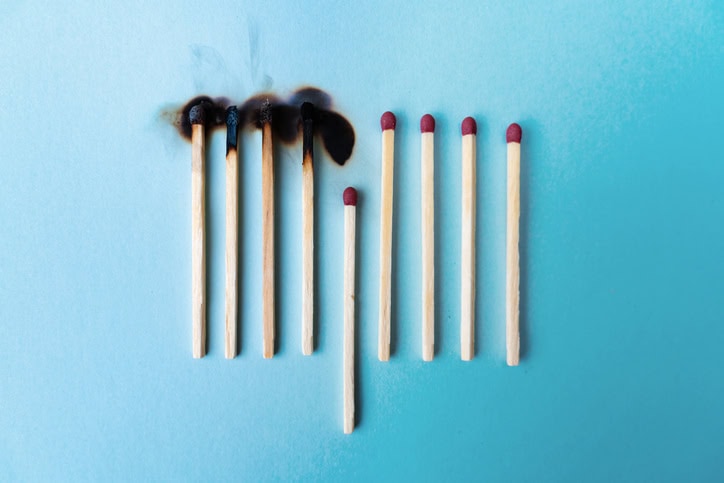
I think what I value most in the time I’ve had with my coach is how during our sessions, the world stills for these wonderments to take shape. In teaching, so many of our day-to-days are seen as “successful” if we are just able to keep our head above water, and the survival mindset means the patterns of our professional behavior easily lend themselves to rinse and repeat because so often, more of the same is all we have bandwidth for. The pause that is afforded in these coaching sessions reminds me of this image on the internet that I keep coming back to, where across a line of matches, one match is removed to break the cycle of flames hopping from one matchstick to the next. I scan the left side of this image, and I see the grind of my world as a teacher, sometimes unaware of the next match lighting amid the slew of to-dos and goings-on. The effect of reflection through coaching sessions is captured through the match that breaks rank, interrupting the burn. That little rebel match represents space and hope and clarity. I stare at the image feeling a strange swell of gratitude for her dissent, for it is this defiance that has cleared much of the fog surrounding what it is I value most about teaching.
Admittedly, I still do not know exactly what lies ahead for me, but the experiences I’ve had this past fall have helped me feel more grounded regarding what the map forward might look like. At the end of the day, there is tremendous power in interrupting the seeming inevitability of our lives, and my wish to the readership is to find your rebel match.
Footnotes
- If you have questions about ethical practices in the fast fashion industry or interdisciplinary problem-solving with South American nonprofit organizations, let’s connect.
- While we are doing shout-outs, three cheers to the rest of my Randolph team—Dave Aulenbach, Dawn Russo, Kristen Siebenhuhner, and Charlie Tobias. You are gems, and I am where I am because of the quality of public school music education you all worked so tirelessly to provide.
Photo at top: Volanthevist | Moment Collection via Getty Images
About the author:
 Lisa Martin is the Academic Editor of Music Educators Journal. She is Assistant Professor of Instruction at Ohio University in Athens, Ohio.
Did this blog spur new ideas for your music program? Share them on Connect! Interested in reprinting this article? Please review the reprint guidelines.
The National Association for Music Education (NAfME) provides a number of forums for the sharing of information and opinion, including blogs and postings on our website, articles and columns in our magazines and journals, and postings to our Connect member portal. Unless specifically noted, the views expressed in these media do not necessarily represent the policy or views of the Association, its officers, or its employees.