NAfME BLOG
Collaborate to Succeed
Evidence-Based Practices for Teachers and Education Support Professionals to Promote Engagement and Prosocial Behavior in Music Classes
By NAfME Member Cameron R. Siegal
This article first appeared in the June 2026 issue of Music Educators Journal.
In my pre-K–5 teaching responsibilities in Dartmouth, Massachusetts, Public Schools, I interact with twenty to thirty education support professionals (ESPs; i.e., paraprofessionals, aides) every week. In many cases, these EPSs are assigned to work one-on-one with specific students with significant needs,1 and most often, the ESPs develop strong relationships with the students they support. In each music class, collaborating effectively with ESPs to promote positive academic and social outcomes is essential. Like many other educators, I have found that there is limited time to collaborate with ESPs on mutually regarded expectations in music class.2 Accordingly, when a collaboration opportunity arises, I see it as a crucial chance for us—as a team—to improve students’ music education experiences through the consistent implementation of research-based instructional practices.
In my own work, I have identified several evidence-based practices that have been particularly useful when supporting students’ unique, individual needs in music classes.3 The strategies presented in this article can serve as a “Choose Your Own Adventure” of sorts; that is, these suggestions can be tailored to your specific students and teaching context. Although this is not a comprehensive list, it can be a helpful start in identifying a plan of action. I not only discuss specific strategies but also provide a concise summary of supporting research so that each team of teachers and ESPs develops a shared understanding toward supporting students’ needs. Although these strategies center students with exceptionalities, they also reflect best practices to support students of all strengths and abilities in the music classroom.
Each challenge students may face is framed with an accompanying question regarding how to improve musical and social outcomes in music class. I then provide an evidence-based strategy to help address that challenge, and I offer an example from my own classes. Ultimately, these ideas are designed to help generate cooperative collaboration between music teachers and ESPs to help improve students’ overall musical experience.
Strategies for Success
Challenge: A student may be struggling to engage or participate in class discussions
Question: How can we support participation for all students?
Strategy: We can give students more processing time
Researchers have demonstrated that providing wait time—that is, time for students to mentally process materials, discussion points, questions, and so on—can promote active engagement.4 For example, with regard to linguistic interaction, increased wait time correlated with “longer responses, greater numbers of voluntary responses, greater complexity of the responses, increased confidence in responding, and better student-to-student interaction.”5 This strategy is particularly important for students developing language skills or other communication skills. Initially, it might feel challenging to embrace extended wait time, given our limited instructional time with students, but ESPs and teachers can work together to optimize this strategy.
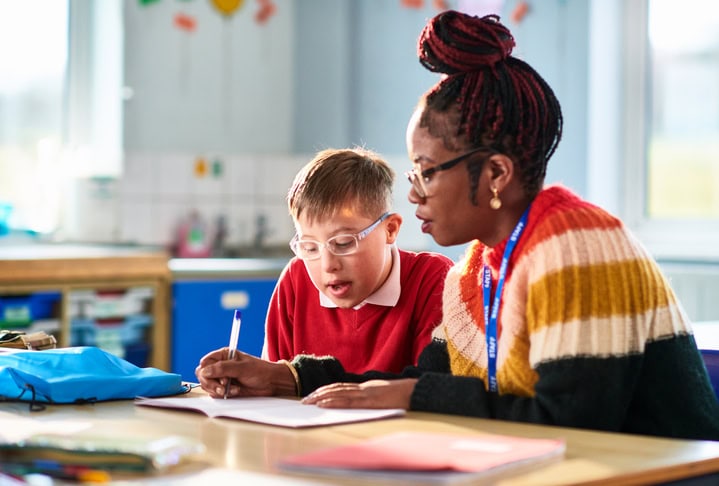
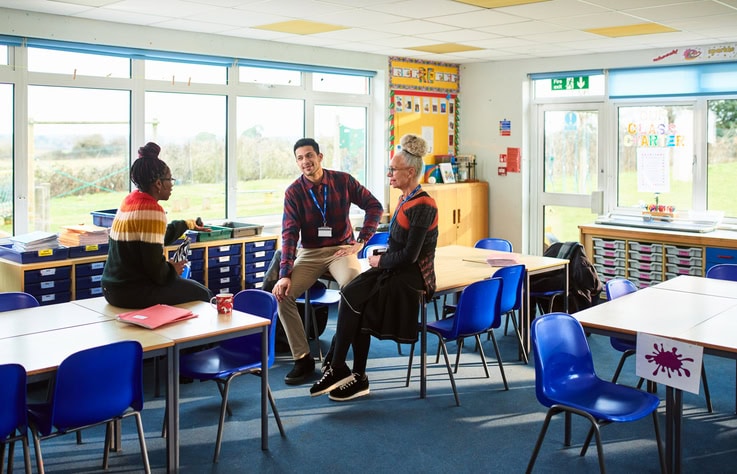
Photo: 10’000 Hours/DigitalVision Collection via Getty Images
Example
Students in a pre-K music class are sitting around the edge of a rug. Students are sharing a song they sing at home with their family, and they are passing around a small stuffie—Ellington Eagle—to indicate whose turn it is to share. The stuffie is handed to a student with an expressive communication disorder. As appropriate for the student’s support plan, rather than speak for or prematurely prompt the student, give the student extended time to respond. In some instances, it might be appropriate to repeat the prompt or provide a sentence frame to the student. Overall, teachers and ESPs should be patient and consistent when providing space for the student to try to respond before giving additional prompts. It is also important to avoid too much pressure; take note of when the student might need space to regroup.
Challenge: A student’s behaviors may deviate from classroom expectations
Question: How can we effectively redirect student behaviors?
Strategy: We can give redirection quietly and privately whenever possible
Music classrooms often feel different from other classroom settings. There are different sounds, movements, and ways of participating that may initially make behavioral expectations feel new or unclear. Invariably, at times, some students will exhibit behaviors that need to be redirected. When a redirection is required, we should strive, whenever possible, to make it quietly so that only the student who is exhibiting disruptive behavior can hear the redirection. Doing so often prompts changes in the students’ actions without further disrupting the class and without drawing undue attention to the student receiving the redirection.6 Using public redirection to modify student behavior can sometimes disrupt class to a greater degree than the original behavior demonstrated by a student. If the disruptive behavior is persistent, other techniques to address the behavior may be appropriate. Teachers and ESPs alike should be familiar with students’ individualized education programs and 504 plans. In addition to knowing what accommodations or modifications are required for each student, these plans provide essential information regarding strategies to implement, individual goals and interests, and so on, all of which can facilitate interaction with students. However, in many situations, private redirection can be incredibly effective.
Another issue with public redirection is that it might reinforce the undesired behavior because the student displaying the disruptive behavior is receiving attention from the adult in front of the class.7 The attention the students receive in such instances might inadvertently serve as a reinforcement. For example, researchers have observed that although teacher corrections may redirect misbehavior momentarily, these interjections did not necessarily decrease students’ disruptive behavior or increase their engagement over time.8
Example
Pre-K students are sitting on the carpet while the teacher is seated on a chair. The teacher is holding a ukulele and asking students to echo (i.e., repeat) the names of various parts of the instrument. A student is prodding another student seated next to them. Teachers and ESPs should refrain from calling out, “Keep your hands to yourself!” Rather, we should quietly walk over to the student, bend down, and quietly remind the student of the expectations. In one of the schools I teach in, we might say, “Remember to stay in your own spaces on the rug.” Using “our” and “let’s” language can also be helpful in these instances. Instead of directing a reminder to an individual, we might remind all students by saying, “Let’s find our spaces!”
Challenge: Support staff may not be familiar with the musical material
Question: How can we provide consistent and developmentally appropriate music-related instruction?
Strategy: We can observe and mirror/follow the music-related feedback
In all cases, we should provide developmentally appropriate feedback for students.9 If ESPs are unfamiliar with a specific music topic, it can be effective to observe and imitate teacher feedback for students. For example, a ukulele lesson for pre-K students will look markedly different from a ukulele lesson for third-grade students due to different expectations and goals for each group. For the pre-K students, it is certainly developmentally appropriate for the children to hold and play the instrument in different ways while experiencing—and experimenting with—the instrument: its sound, look, feel, and so on. Although I demonstrate the characteristic grip, playing posture, and basic playing technique before giving students the chance to try the instrument, I am not overly concerned about how pre-K students are holding or playing the ukulele the first time. This protocol is particularly applicable for some of our youngest students (e.g., three- and four-year-olds). Students, regardless of whether they hold the instrument “correctly,” are building “conceptual structures through self-generated evidence.”10 As they experiment with the instrument, students experience what movements generate or inhibit sound production. Researchers have noted that the embodied cognition of haptic feedback (e.g., vibrations) is an essential element of multimodal music lessons for students with severe or multiple disabilities.11 To boil it down regarding the youngest students, as long as the students are being gentle with the instrument and are participating, I am satisfied for the first lesson.
Example
Twelve pre-K students (predominantly students ages three and four) are sitting around the carpet following a brief introductory lesson on the ukulele. Students are paired off, and while handing a ukulele to one student in each pair, I help each student hold the ukulele with the characteristic grip. After walking to another group, a student changes the grip and begins to experiment. We should not tell the student, “No, not like that!” Rather, let the student experiment with the instrument as long as they are being gentle. After a lesson or two, we can start to more consistently expect students to demonstrate the characteristic grip. When I do want a student to alter their grip, I might demonstrate the skill again and say, “Let’s remember to support the neck like this.”
Challenge: Distinct, varied music content requires specialized approaches to supporting meaningful engagement
Question: How can we promote engagement in a dynamic and energetic environment?
Strategy: We can maintain situation awareness of learning activities
Music classes are multifaceted. While performing, creating, connecting ideas to music, and responding to music, students will listen, play instruments, sing, move to music, talk about music, interpret music, and more. Each type of activity requires different behaviors from not only the students but also the teacher and ESPs. For example, while working in small groups to compose using drums, recorders, and rattles, expectations for students will be different from expected behaviors when students are listening to a musical work and interpreting artistic intent. Accordingly, it is essential that the adults in the room maintain awareness of student expectations and model the desired behavior.12 For example, when students are listening to music, singing, or receiving teacher directions, teachers and ESPs should all model active listening.13 As the adults in the classroom, our side conversations can be distracting and negatively impact students’ focus.
Example
Students in an adaptive classroom or substantially separate classroom are listening to a musical work and attempting to discern the mood of the music before they share their opinion with the class. In this case, we should all model active listening whenever possible.
Challenge: Students may feel anxious in school
Question: How can we create a welcoming and supportive educational environment for all students?
Strategy: We can model affirming behaviors and frame comments in a positive way whenever possible
The potential to promote positive behaviors while suppressing undesirable behaviors with praise and positive comments should not be overlooked. At one of my current schools, the seasoned principal is an expert at modifying the behavior of students in groups using selective praise, and I have imitated this technique with significant success. The efficacy of this anecdotal technique is borne out in the research literature. Researchers have demonstrated that teachers’ praise-to-reprimand ratios correlate with on-task behaviors.14 Nicholas Newton and colleagues observed that behavior-specific praise positively related to on-task behavior for students with emotional or behavioral disorders.15 Additionally, increasing praise-to-reprimand ratios seems to improve educator well-being. Researchers have demonstrated that teachers who had lower praise-to-reprimand ratios experienced higher levels of emotional exhaustion.16
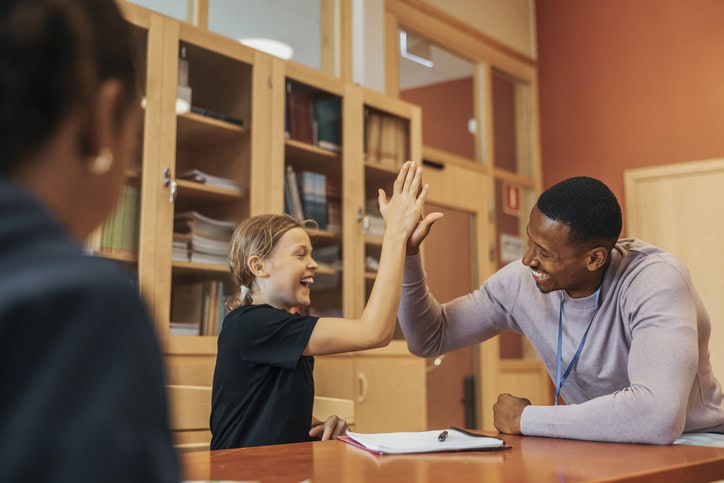
Photo: Maskot/DigitalVision Collection via Getty Images
Example
Students quietly enter the music room and sit on risers at the start of music class. Although the expectation is for students to sit with their legs in front of them, several students are sitting sideways so that their feet are between risers. Rather than admonishing the students who are not meeting expectations, we can praise individual students who are sitting in the preferred way, for example, “I like the way Chloe is sitting. I like the way Jordan is sitting.” And so on. Often, the students who are not meeting expectations will modify their behavior. When they do, it is prudent to praise their behavior. In this way, you can promote prosocial behaviors positively and diminish negativity.
Concluding Remarks
ESPs and teachers together face challenging roles in which they are expected to fulfill a wide range of responsibilities.17 Although some of the instructional techniques that music teachers apply in their classrooms will be analogous to different content areas, some may differ. Even within the area of music, teachers will invariably have different methods of delivery and expectations for students and ESPs. Recognizing these considerations, I hope that this article conveys not only collaborative techniques to employ in a concise and practical format18 but also the rationale and the basis of the strategies in research literature. It is my goal to provide the best possible music education for each and every student, and only when we—teachers and ESPs—work together with a unified approach to instructional delivery are we able to progress toward that goal.
Interested in learning more about this topic? Register now for the September 9, 2026, NAfME professional learning webinar “Promoting Music Engagement for Students with Profound Intellectual Disabilities.” (This webinar recording will be available in NAfME Academy® after the event.)
Footnotes
- Elaine D. Bernstorf, “Paraprofessionals in Music Settings: Paraprofessionals Who Provide Assistance to Students with Special Needs Can Assume a Number of Roles in the Music Classroom Setting,” Music Educators Journal87, no. 4 (2001): 36–48.
- Rachel Grimsby, “Alternative Avenues for Collaborating with Special Education Paraprofessionals,” Journal of General Music Education36, no. 2 (2023): 13–19; Claire Majerus and Donald M. Taylor, “Elementary Music Teachers’ Experiences Training and Collaborating with Paraprofessionals,” Update: Applications of Research in Music Education 39, no. 1 (2020): 27–37.
- Alice-Ann Darrow, “Working with Paraprofessionals in the Music Classroom,” General Music Today23, no. 2 (2010): 35–37.
- Gary D. Borich, Effective Teaching Methods, 2nd ed. (Maxwell Macmillan International, 1992); Mary Budd Rowe, “Wait-Time and Rewards as Instructional Variables, Their Influence on Language, Logic, and Fate Control: Part One—Wait-Time,” Journal of Research in Science Teaching11, no. 2 (1974): 81–94; Kenneth G. Tobin, “The Effect of an Extended Teacher Wait-Time on Science Achievement,” Journal of Research in Science Teaching 17, no. 5 (1980): 469–75; Barbara A. Wasik and Annemarie H. Hindman, “Why Wait? The Importance of Wait Time in Developing Young Students’ Language and Vocabulary Skills,” Reading Teacher 72, no. 3 (2018): 369–78.
- James H. Stronge, Qualities of Effective Teachers, 3rd ed. (ASCD, 2018).
- Haley M. K. Steinhauser and William H. Ahearn, “Response Interruption and Redirection,” in Handbook of Applied Behavior Analysis for Children with Autism, ed. Johnny L. Matson (Springer, 2023).
- Lauren W. Collins and Timothy J. Landrum, “Using Behavioral Interventions to Build Relationships with Students with Challenging Behavior,” TEACHING Exceptional Children55, no. 3 (2023): 188–97.
- Paul Caldarella, Ross A. A. Larsen, Leslie Williams, Howard P. Wills, and Joseph H. Wehby, “‘Stop Doing That!’: Effects of Teacher Reprimands on Student Disruptive Behavior and Engagement,” Journal of Positive Behavior Interventions23, no. 3 (2021): 163–73.
- Hyowon Gweon, “Inferential Social Learning: Cognitive Foundations of Human Social Learning and Teaching,” Trends in Cognitive Sciences25, no. 10 (2021): 896–910.
- Zi L. Sim and Fei Xu, “Learning Higher-Order Generalizations through Free Play: Evidence from 2- and 3-Year-Old Children,” Developmental Psychology53, no. 4 (2017): 642–51.
- Melissa Bremmer, Carolien Hermans, and Vincent Lamers, “The Charmed Dyad: Multimodal Music Lessons for Pupils with Severe or Multiple Disabilities,” Research Studies in Music Education43, no. 2 (2021): 259–72.
- Mica R. Endsley, “Situation Awareness,” in Handbook of Human Factors and Ergonomics, 5th ed., ed. Gavriel Salvendy and Waldemar Karwowski (John Wiley & Sons, 2021); Riitta-Leena Metsäpelto, Anna-Maija Poikkeus, Mirva Heikkilä, et al., “A Multidimensional Adapted Process Model of Teaching,” Educational Assessment, Evaluation and Accountability34, no. 2 (2022): 143–72.
- Paul J. Taylor, Darlene F. Russ-Eft, and Daniel W. L. Chan, “A Meta-Analytic Review of Behavior Modeling Training,” Journal of Applied Psychology90, no. 4 (2005): 692–709.
- Paul Caldarella, Ross A. A. Larsen, Leslie Williams, Kade R. Downs, Howard P. Wills, and Joseph H. Wehby, “Effects of Teachers’ Praise-to-Reprimand Ratios on Elementary Students’ On-Task Behaviour,” Educational Psychology40, no. 10 (2020): 1306–22; Nancy A. Neef, Michael Kranak, Marnie Shapiro, Ziwei Xu, and A. Charles Catania, “Changing What Teachers Say Changes What They Do: Increasing Their Specific Praise of Student Behavior,” Journal of Behavioral Education 33, no. 2 (2022): 344–57.
- Nicholas A. Newton, David James Royer, Jennifer A. Hogg, and Amber Priddy, “Behavior-Specific Praise: Enhancing On-Task Behavior in a Rural Elementary School,” Frontiers in Education9 (2024): 1445523.
- Wendy M. Reinke, Keith C. Herman, and Melissa Stormont, “Classroom-Level Positive Behavior Supports in Schools Implementing SW-PBIS: Identifying Areas for Enhancement,” Journal of Positive Behavior Interventions15, no. 1 (2013): 39–50.
- Karen B. Patterson, “Roles and Responsibilities of Paraprofessionals: In Their Own Words,” TEACHING Exceptional Children Plus2, no. 5 (2006): 1–13.
- Michael F. Giangreco, Jesse C. Suter, and Mary Beth Doyle, “Paraprofessionals in Inclusive Schools: A Review of Recent Research,” Journal of Educational and Psychological Consultation20, no. 1 (2010): 41–57.
About the author:
NAfME member Cameron R. Siegal (csiegal@ric.edu) is a pre-K–5 music teacher in the Dartmouth, Massachusetts, public schools and an adjunct professor of music education at Rhode Island College in Providence, Rhode Island.
Did this blog spur new ideas for your music program? Share them on Connect! Interested in reprinting this article? Please review the reprint guidelines.
The National Association for Music Education (NAfME) provides a number of forums for the sharing of information and opinion, including blogs and postings on our website, articles and columns in our magazines and journals, and postings to our Connect member portal. Unless specifically noted, the views expressed in these media do not necessarily represent the policy or views of the Association, its officers, or its employees.