NAfME BLOG
FY 2027 Appropriations Heat Up
Support Arts Education Funding
By Amber Friel, NAfME Communications Manager, Advocacy and Public Policy
As federal appropriations discussions begin for Fiscal Year 2027 (FY 2027), a critical moment has arrived for arts education advocates across the country. Decisions made in the coming weeks will shape the future of quality, access, and equity in arts education, and your voice is more important than ever.
New Budget Proposes Major Cuts and Limits Access
On April 3, shortly after Congress decided to maintain level funding for most K–12 programs for FY 2026, President Trump released his administration’s FY 2027 budget proposal. Overall, the plan requests $76.5 billion for the Department of Education—a $2.3 billion (2.9%) decrease from the previous year.
For arts education, the implications could be significant. The proposal calls for the complete elimination of several key federal funding streams, including:
- Assistance for Arts Education, which supports professional development for arts educators, accessible instructional materials, and partnerships among schools, districts, and arts organizations
- Title II, which funds educator recruitment and retention, builds professional expertise, and increases the number of high-quality educators nationwide—including arts instructors.
- Title IV-A (Student Support and Academic Enrichment Grants), which provides flexible funding for a well-rounded education including the arts, safe and healthy students, and the effective use of technology.
- Nita M. Lowey 21st Century Community Learning Centers, which support before-school, after-school, and summer learning programs in low-performing schools.
Under this proposal, these programs—along with 13 others—would be consolidated into a “Make Education Great Again” (MEGA) block grant. Proposed at just $2 billion, this funding level is $4.6 billion less than the combined total of the programs it would replace. While states would retain some flexibility, required allocations for literacy (25%) and math (25%) would further limit resources intended specifically for arts education.
 Data from the Arts Education Data Project show that only 15% of schools nationwide offer instruction in three arts disciplines, and just 9% offer four or more. More than 2 million public school students lack access to any arts education at all, and schools serving high proportions of students eligible for free or reduced-price lunch are nearly twice as likely to offer none. These gaps are especially pronounced in low-income and rural areas, where limited access affects not only students but entire communities.
This is why continued advocacy for dedicated federal funding streams that strengthen arts education quality, equity, and access is so important.
Arts Education Funding Streams Are Critical
An unfortunate reality is that when education funding is constrained, arts programs are often among the first to be reduced or eliminated. Despite well-documented benefits—including improved attendance and behavior, stronger academic outcomes for low-income students, and opportunities for meaningful personal development—arts education is frequently deprioritized, depriving students and their communities of enriching experiences.
Findings from the Arts Education Alliance’s March 2026 report, Arts Education Funding: A Two-Year National 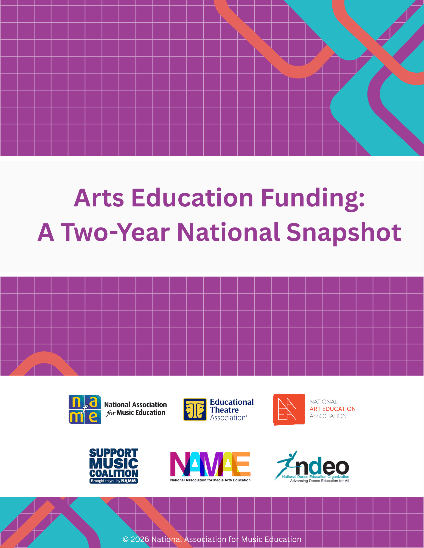 Snapshot show that, when available for arts programs, federal funds are most frequently used for instructional materials and supplies, including textbooks and digital resources, as well as instruments and equipment. More than one in five respondents also reported using federal funds to support professional learning, staffing, curriculum development, and facilities improvements. These investments are meaningful and often transformative, but unmet needs remain high in staffing, facilities, equipment, and long-term sustainability, highlighting that current funding levels already fall short of meeting the full scope of need.
Take Action: Speak Up for Arts Education
That’s why we’re calling on arts education advocates nationwide to contact their members of Congress directly and urge support for the following FY 2027 funding levels:
- Title I: $18.68 billion
- Title II: $3 billion
- Title IV-A: $1.6 billion
- Assistance for Arts Education: $40 million
- National Endowment for the Arts: $213 million
- Nita M. Lowey 21st Century Community Learning Centers: $2.09 billion
- Individuals with Disabilities Education Act (IDEA): $16.66 billion
Personalizing your message and sharing this call to action with your network can amplify its impact and help ensure lawmakers understand the importance of these programs.
During the FY 2026 appropriations process, more than 930 advocates contacted their members of Congress through a grassroots campaign led by NAfME in partnership with NAMM, while more than 2,300 advocates participated through a broader Arts Education Alliance campaign. Together, these collective efforts helped persuade Congress to reject proposed cuts and maintain critical education funding.
That success demonstrates the power of advocacy, but it also highlights what’s at stake. Continued engagement is essential to ensure that arts education programs not only survive but thrive.
Learn more about the Arts Education Alliance and the impact of federal funding on music and arts education.
Interested in reprinting this article? Please review the reprint guidelines.