NAfME BLOG
Guitar Teaching Focused on Creative Development and Composition Skills

Teaching Guitar for Ages 5–11
Fostering Creativity and Compositional Mastery
By NAfME Member Oleksiy Bilous
Objective of the Article
This article aims to present a methodology for teaching children of preschool and early primary school age how to play the guitar, with an emphasis on nurturing their creative development and ability to compose music. Based on theoretical research and practical experience, this guide lays the foundation for developing composition skills and creative self-expression. The methodology can serve as a supplement to theoretical and practical programs.
Introduction
As a practicing musician and guitar teacher, I have observed many colleagues and students. From these observations, I identify two types of musicians:
- Highly skilled technical musicians who flawlessly perform both solo and band parts, but often struggle to invent their own parts or improvise.
- Musicians with limited technical skills but exceptional in their sense of music and compositional talent.
Ideally, a musician should work on developing both aspects. However, these are often seen as mutually exclusive, and many find it difficult to focus on mastering both simultaneously.

Photo: Jose Luis Pelaez / Stone Collection via Getty Images
I recall my childhood experience at music school. At 13, I had a strong desire to learn guitar. The school focused on classical music education, and I didn’t understand why I was made to play the same sequences of notes for months—sequences that offered no aesthetic value. I felt I was doing more physical exercises than musical ones. After a few months, I believed it was beyond my reach to play even a simple song by The Beatles or to express melodies that were forming in my mind through my instrument.
I quickly left that music school and, perhaps, would never have returned to guitar and music if I had not met a musician and teacher who immediately understood what I needed. He introduced me to a simple sequence of four chords: G – Em – C – D. He told me to learn these chords, promising that he would show me a hundred songs built on this progression. I was amazed at how simple it was! This became my key to exploring the world of music, guitar, and composition on my own.
Later, I realized I needed to study music theory and develop my technical skills further. But this story illustrates the importance of choosing the right approach and methodology from the start.
Most schools focus heavily on basic technique and fundamental theory—which is essential. My goal is to develop a method based on research and my own practice that will lay a foundation for composition and creative self-expression from an early age. Every musician is talented in their own way: Some can perform already composed music extraordinarily well, which requires years of technical practice, while others can invent a brilliant melody with only a few basic chords. An attentive teacher should recognize each student’s strengths and tailor the curriculum to develop these talents—especially crucial for preschool and early primary students.
We use music to extend and express ourselves. Composition is a way of sharing one’s self and one’s felt experiences with others. Composition presents us a means by which to share things too precious and too intimate to be limited by words. Most importantly, regardless of an individual’s background, propensities or skills, composition can contribute to personal development within each of those aspects. At no point is a musician more vulnerable than when composing and sharing the results with others. Music education can serve to assist students in developing an awareness of design that enhances all of these abilities and experiences. By creating works of one’s own, students come to better understand the works of others. It is the nature of music to express principles through interrelation of the musical elements. This is achieved by the use of compositional devices. All of these—principles, elements, and devices—can and should be taught to children to foster greater compositional expressivity.1
Despite the inclusion of composition in music curricula in the United States, understanding the role of creativity in composing in schools remains a fragmented and difficult issue.2
Training in guitar playing, aimed at creative development and the ability to compose music, requires specialized approaches and methods depending on the student’s age. This methodology is based on three age groups: preschool (5-6 years), and early school age (7-8 and 9-11 years). Practical observations show that such a division helps to find the best approach to the student and achieve maximum results in instrument mastery and overall musical and creative development.
The guitar teaching methodology for preschool and early school age children, focused on creative growth and the ability to create music, must consider the psycho-physical development characteristics of children, as well as ways to stimulate their creative abilities through playing the instrument.
1. Psychological and Age-Related Features
Before considering the teaching methodology, it is important to take into account children’s age features, as they influence the most effective approaches and methods.
Cognitive Development
Children aged 5–11 are at a stage where their cognitive abilities are actively developing. They begin to perceive information more consciously, handle multi-step tasks more easily, and understand more complex concepts. However, their capacity for abstract thinking is not yet fully developed, so teaching should be concrete, using images and associations.3
Emotional and Motivational Development
Children of this age are highly emotional. Music has a strong impact on them, and it is important that the learning process is engaging, bright, and inspiring. They enjoy games and competitions, and gladly learn melodies they find beautiful and emotionally rich. Therefore, teaching should include game elements, allowing children to express their creativity and emotionality.4
Motor Skills Development
At age 5–11, children are quite good at controlling their movements, but hand-eye coordination may still be developing. Therefore, guitar lessons should focus on developing fine motor skills of the hands, which will improve technique and overall growth.5,6
2. Incorporating a Play-Based Approach
Play Element
For children of this age, the play component is crucial.7 Music-related games and tasks can significantly increase their interest.8 For example, games that involve recognizing notes and chords, where children search for hidden melodies or compete with friends in sound recognition, help develop musical ear, attention, and stimulate creativity.
Gradual Complexity
Tasks should match the child’s abilities and age features. Starting with simple melodies and chords, then gradually moving to more complex pieces, helps develop technical skills and allows a child to feel progress and confidence.
Integration of Theory and Practice
A key aspect is combining theory and practice. Children should not only learn chords and exercises, but also understand their meaning and how they interact in a musical context. Teaching basics of music theory through simple, understandable examples that can be applied in playing is essential.9
Creative Freedom
Playing guitar should foster a creative approach.10 It is important that children not only study others’ compositions but also create their own. This could involve composing simple melodies or improvising to express their emotions and feelings. Using basic chords as a foundation, children can develop their own musical pieces.
3. Division into Age Groups
From a psycho-emotional perspective, children aged 5–11 can be divided into several groups to better adapt teaching methods.11
- Preoperational Stage (2–7 years): Children develop language, imagination, and symbolic thinking but cannot yet think logically or perform operations.
- Stage of Concrete Operations (7–11 years): Children can perform logical operations with tangible objects and real situations, developing reasoning and understanding cause-and-effect relationships.
Based on practical experience, a more detailed division is proposed, which can be adjusted based on individual observation:
- Preschool Age (5–6 years)
Features: Learning through play, concrete thinking prevails, high emotional reactions to music. They need lots of emotional support.
Approaches: Use games, movement activities, simple melodies, and interactive elements that evoke emotional responses.
2. Early School Age (7–8 years)
Features: Beginning of abstract thinking; children can understand simple notation. They may be more autonomous but still need guidance and emotional support.
Approaches: Integrate teaching of notes and basic musical terms with practical playing; use team games to develop social skills.
3. Middle Early School Age (9–11 years)
Features: Greater independence; interests can become more individual; start taking responsibility for achievements; capable of expressing emotions through music.
Approaches: Teach more complex musical concepts, develop individual playing styles, improvisation, and encourage personal projects and performances.
Based on these features, practical lessons aimed at developing composition and creative abilities are recommended.
Photo: Ableimages / DigitalVision Collection via Getty Images
Practical Activities for Children Aged 5–6
-
Play-Based Approach and Motivation
An essential element of the methodology is the use of game-based learning. At this preschool age, students best absorb information through play. During these activities, they develop attention, memory, listening skills, coordination, and, importantly, their creative abilities. Incorporating improvisation and composing within guitar play allows children to feel like creators.
Examples:
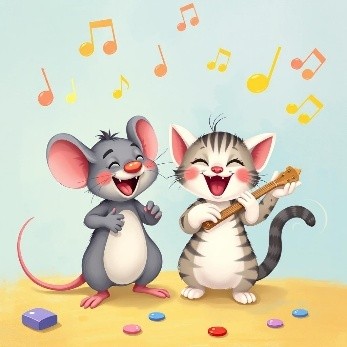
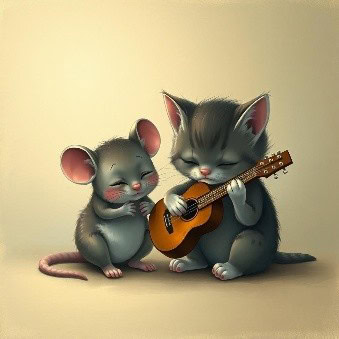
- Musical Stories Game: where each child adds their own “music” to a story, creating melodies that reflect the emotions of the characters. For example, showing pictures expressing joy, sadness, or anger:
 |
 |
 |
Demonstrate how these emotions can be expressed on the instrument, even at a beginner level:
-
- Joy: major chord (A) and energetic, fast strumming.
- Sadness: slow fingerpicking of a basic minor chord (Em).
- Anger: vigorous strumming of the lower strings (E and A) with a “march” rhythm.
-
Using Elements of Improvisation
The next step can be practicing simple melodies and adapting them based on the student’s personal feelings. To develop creative thinking and musical ear, it’s important that children are involved in creating music. Start with simple improvisations, for example, using open strings or basic chords.
Examples:
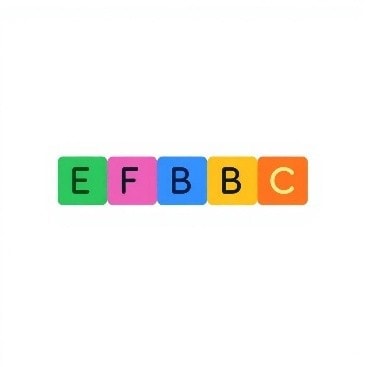
- Crafting short musical phrases composed of a few notes, then modifying them. For instance, show that even knowing three notes on the first string — E, F, G — they can be played in different sequences or repeated: G G F E or F E F E. Encourage the child to come up with their own sequence and record it.
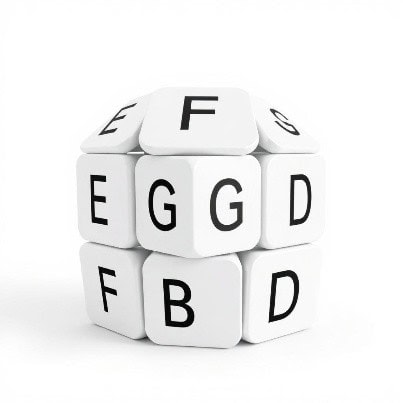
- Using a “Melodic Cube,” where each side shows a different note. The child rolls the cube and creates unique musical phrases by combining the notes. For example, rolling the cube eight times and recording the sequence, then playing those notes.
 |
 |
-
Musical Game with Composition Elements: “I Am a Composer”
Based on simple chords and familiar melodies, children can compose their own pieces by modifying well-known motifs. It’s crucial not only to explain the rules and chords but also to give opportunities to experiment with tempo, rhythm, and dynamics.
Examples:
- Try replacing a few notes in a well-known simple song. Demonstrate to the student how this can be done. For example, take the song “Happy Birthday.”
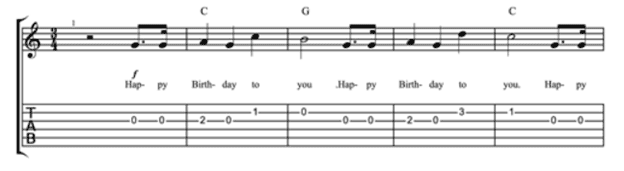
- Change a couple of notes—swap the G notes in the third measure with A. Then let the student try replacing a note themselves, experimenting with various options. Have them choose their favorite variant and record it.

-
Exploring Different Musical Styles
To help the student develop their creative individuality, introduce them to various musical styles. This broadens their musical understanding and provides more avenues for self-expression.
Examples:
- Listening to the same song, “Happy Birthday,” performed in different styles: jazz, hard rock, country, etc.
-
Regular Reflection and Self-Analysis of Music
Preschool children might not consciously see themselves as creators, so it’s important to involve them in analyzing what they have made. This process helps them recognize their creative role and appreciate their contributions.
Examples:
- Discussing the melodies they created and the emotions they intended to convey.
- Listening to their own recordings and talking with the teacher about how the music could be made even more interesting or expressive.
-
Encouraging Group Creativity
Collaborative work fosters communication skills and musical intuition. Developing student’s ability to work in a team, support each other, and nurture a creative atmosphere is vital.
Examples:
- Group music creation, where each child contributes their idea to a joint composition.
- Group improvisation sessions, allowing children to interact and create music together.
Conclusion
A guitar teaching methodology for preschoolers focused on developing creative skills should combine elements of play, improvisation, and independent creativity. It should stimulate children’s imagination, musical ear, and the ability to craft original melodies—always taking into account each child’s individual characteristics.
Practical Activities for Children Aged 7-8
-
Modified “Musical Stories” Game
At this age, the game can be further adapted. While in preschool the focus was on static expressions of basic emotions in isolated moments, here it’s important to show that emotions and stories are dynamic, evolving and changing over time.
Example:
Take a video where a cartoon character walks briskly, cheerfully, with a smile. What emotions does the character feel? How can we represent this musically? First, through tempo and rhythm. Play a guitar strum in time with their steps, using a major chord progression.
Then, consider a video of the same character walking gloomily, head down, sighing. What tempo and rhythm should match their gait? What chords would fit?
Beforehand, show such clips from cartoons with a matching musical accompaniment. Discuss how these elements convey emotion.
-
Learning Keys and Chord Progressions
Begin with the fundamentals: study the basic chords of G major and its relative minor, E minor. Learn several progressions: G – Em – C – D, G – C – D – G, G -D – Em – G. Challenge the student to craft their own progression.
It’s essential to understand that chords form the foundation of harmony. Select five songs built on the progression G – D – Em – C:
- John Denver — Take Me Home, Country Roads
- Bob Marley — No Woman No Cry
- Beyoncé — If I Were a Boy
- Ed Sheeran — Perfect
- Jason Mraz — I’m Yours
-
Developing Ear and Melodic Perception
One of the key aspects of creative growth is musical ear training. It’s important to develop the child’s ability to distinguish tonality, chords, intervals, and their combinations to help them create harmonious musical phrases.
For this age group, introduce a listening game for chord recognition:
Game: “Musical Detectives” — designed to develop listening skills and help children identify musical intervals and chords.
Preparation:
Create flashcards with images of different chords (Em, D, G, A, Am, A7).
Rules:
The teacher plays a chord on the guitar. The student listens and tries to identify it. Afterward, they point to the correct card.
Explanation:
After each response, the teacher can highlight features of the chord, explain why they sound as they do, or share interesting facts about them.
Ask the student to name their favorite chord, explain why they like it, and describe what emotions it evokes.
-
Introducing Basic Principles of Harmony and Melody
Start with simple musical phrases that a child can adapt and change. Using basic chords and familiar melodies, encourage children to compose their own pieces by modifying known motifs.
It’s important not only to explain rules and chords but also to give children the opportunity to experiment with tempo, rhythm, and dynamics.
Musical Game: “I Am a Composer” can be adapted for this age. Instead of working on just a short extract, children can be tasked with creating a longer section of a song, such as a verse and chorus. If we tried this together with a younger group, it was done collaboratively. For this age, you can assign it as homework, giving children time to focus and reflect on their note choices and modifications.
Conclusion
It’s vital to demonstrate that music is interconnected with emotions and real-world experiences. Music is born and evolves alongside our feelings, reflecting the human experience.
Practical Activities for Children Aged 9-11
At this stage, students can begin exploring harmony and tonality. I propose a methodology that encourages students to transition naturally from practice to theory—more accurately, from an understanding of why theory is important to their playing, to an active curiosity about it. This phase requires familiarity with basic tonalities, including notes and fundamental chords within those keys.
-
Selecting Chords
Choosing chords that match a melody is a crucial aspect of musical composition, helping to create harmony and emphasizing the emotional content of the music.
Try this experiment: show the student a musical piece where different chords are layered over the same melodic fragment in different sections. For example, Ode to Joy. Focus their attention on the melody and chords in the first, second, and third measures:
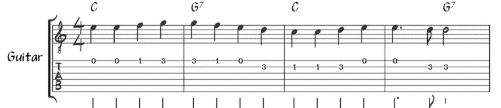
Now, draw attention to the melody and chords in measures five, six, and seven:
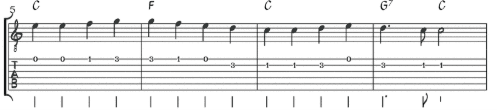
The melody remains the same, but the chords differ. In the first case, it’s a progression: C – G7 – C; in the second: C – F – C. Discuss with the student how changing the harmony alters the mood of the piece. Encourage experimenting with other chords from the key of C major that would also suit the melody.
-
Transposing to Different Keys
Have the student transpose a previously learned song to a different key. Discuss how the sound of the song changes after shifting the key and the fingerings of the chords. Learning chords can be approached using progressions written as scale degrees. Listen to how the following common chord progressions sound in different keys, exemplified through well-known songs:
- I–V–vi–IV in Let It Be (C major)
- I–V–vi–IV in Take On Me (A major)
- I–V–vi–IV in Under the Bridge (E major)
- I–V–vi–IV in We Found Love (F major)
- I–V–vi–IV in With or Without You (D major)
-
Chords with Extensions
Play the “Chord Creators” exercise: challenge the student to invent their own chord. Beginners often know only basic chords and may not fully understand how complex chords are constructed. Exploring the guitar neck allows students to experiment with combinations of notes, creating new chords that they haven’t learned before.
For example, a student might show a chord like this:

The teacher explains that its name is Amaj7. Clarify what a maj7 chord is and how it’s built. Show the sequence of chords where this chord might be used, and listen to a song employing it.
This opens the way to studying more complex chords with extensions. Find an example of a song played with simple chords and the same song with extended chords for comparison.
-
“I Am a Composer” Game
Challenge the child to create their own melody or riff based on a given chord progression, such as:
C – Am – F – G.
Encourage experimenting with rhythmic variations, melodic ideas, and expressive elements. This activity fosters creativity and helps students internalize harmonic structures by applying them in their own compositions.
Conclusions: Methodical Approaches and Exercises
- Learning Chords and Progressions
One of the first steps on the path to creativity is mastering basic chords. For younger children, it is important to start with simple chords. Gradually, teach them chord progressions that form the foundation for composing musical pieces. Exercises aimed at developing the ability to change chords quickly not only enhance technical skills but also help children learn to create musical phrases effectively. - Composing Simple Melodies
Once the child has mastered basic chords, encourage them to compose simple melodies. A helpful approach is the “changing one element” principle—for example, modifying a melody by varying note durations, adding pauses, or changing rhythms. This fosters musical perception and teaches children how to develop musical phrases and ideas creatively. - Improvisation and Experimentation with Rhythm
Improvisation is a vital element of creative growth. Even at the early stages, children can be given improvisation tasks—such as creating a melody based on a specific rhythm or chord progression. Encourage them to experiment by changing tempos or playing in different styles. These activities develop not only their listening skills but also their ability to experiment and express themselves through music. - Visualization of Music
To enhance understanding of musical structures, visualization methods can be very effective. For example, children can draw images or diagrams representing the form of a piece, or use color coding to indicate chords and notes. This helps them better grasp how musical structures work in practice and how to apply this knowledge creatively in their own compositions.
Conclusion
Teaching guitar to children aged 5-11 involves more than just acquiring playing skills; it’s a crucial stage in their creative development. A methodology focused on fostering creativity should be flexible and tailored to each child’s individual characteristics, interests, and emotional perception of music. Creating an environment where children can develop their musical abilities, experiment with composing, improvising, and expressing their feelings through playing will nurture their inner potential. An artistic approach to learning not only helps children master the instrument but also unlocks their inner creativity, supporting their ongoing musical growth and developing a lifelong love for music.
Citations
- Kaschub, M., & Smith, J. P. (2009). A principled approach to teaching music composition to children. Research and Issues in Music Education, 7(1). Retrieved from http://www.stthomas.edu/rimeonline
- Burnard, P. and Younker, B.A. (2004). Mapping pathways: fostering creativity in composition. Music Education Research, 4(2), 245-61.
- Barbara Pastuszek-Lipińska, The role of musical aspects of language in human cognition, Frontiers in Psychology, 10.3389/fpsyg.2025.1505694, 16, (2025).
- Emanuel Maldonado, Musical Education in Kindergarten. Importance on the quality of life in children, Health Leadership and Quality of Life, 10.56294/hl2024.463, 3, (2024).
- Bruin, L. (2023). Instrumental music teachers’ development of feedback across the lifespan: a qualitative study. International Journal of Music Education, 42(1), https://doi. org/10.1177/02557614231151445
- Amy Ellis Nutt, “Music lessons spur emotional and behavioral growth in children, new study says,” The Washington Post, January 7, 2015
- ALLEE-HERNDON, K. A. & ROBERTS, S. K. (2021). The power of purposeful play in primary grades; adjusting pedagogy for children’s needs and academic gains. Journal of Education, 201, 54–63.CrossRef, Google Scholar
- Vinay Kumar, KS Pavitra, Rahul Bhattacharya, Creative pursuits for mental health and well-being, Indian Journal of Psychiatry, 10.4103/indianjpsychiatry.indianjpsychiatry_781_23, 66, Suppl 2, (S283-S303), (2024).
- Vinay Kumar, KS Pavitra, Rahul Bhattacharya, Creative pursuits for mental health and well-being, Indian Journal of Psychiatry, 10.4103/indianjpsychiatry.indianjpsychiatry_781_23, 66, Suppl 2, (S283-S303), (2024).
- Burnard P. (2012b). Rethinking ‘musical creativity’ and the notion of multiple creativities in music. In Odena O. (Ed.), Musical creativity: Insights from music education research (pp. 5–28). Ashgate Publishing. CrossRef, Google Scholar
- Piaget, J. (1970). The science of education and the psychology of the child. New York: Viking Press.
Editor’s Note 1: Special thanks to members of the NAfME Council for Guitar Education for their review of this article.
Editor’s Note 2: Acknowledging this may apply to private studio teachers, we also encourage you to consider joining as a NAfME Associate Member to take advantage of membership benefits.
About the author:
 NAfME member Oleksiy Bilous is a dedicated guitar teacher and mentor with extensive experience working with students of all ages. Formally trained as a journalist, he has taught at journalism institutes and facilitated seminars while pursuing advanced studies. His self‑taught mastery of music theory and songwriting complements his professional teaching roles. Since August 2023, Oleksiy has been teaching at Expressions Music Academy in Vienna, Virginia, where his methodology emphasizes creative development and composition. From May to September 2024, he also served as a part‑time guitar instructor at The Guitar Center Company in Falls Church, Virginia. As a guitarist, vocalist, and songwriter with Red Berlin, he performed nationally and composed original works.
Did this blog spur new ideas for your music program? Share them on Connect! Interested in reprinting this article? Please review the reprint guidelines.
The National Association for Music Education (NAfME) provides a number of forums for the sharing of information and opinion, including blogs and postings on our website, articles and columns in our magazines and journals, and postings to our Connect member portal. Unless specifically noted, the views expressed in these media do not necessarily represent the policy or views of the Association, its officers, or its employees.