NAfME BLOG
Harmonic and Divergent: Navigating Giftedness and Neurodiversity in Music
The Not-So-Easy Prodigy
By NAfME Member Jaime Surdynski
“Gifted kids have it so easy!” and “It must be easy to teach music when all your students are prodigies!” are two of the most common sentiments expressed when someone learns I teach at a school for the academically bright and gifted, but “easy” doesn’t paint the whole picture.
As the Illinois Association of Gifted Children observes, “Gifted children learn faster and think deeper than their age-mates. Fundamentally, this is a learning difference, and can cause disconnects, particularly in the classroom.”
To help these neurodivergent learners grow as musicians requires educators to shift away from the myths about music always coming easily to gifted students and lean into neuro-inclusive classrooms and strategies.
The Reality of a Gifted Brain
While gifted and talented students often experience early success in the creative arts, the growth is frequently asynchronous. Intellectual, physical, and emotional growth progress at different rates. While our vocabulary around this topic may have evolved, the notion of asynchronous development is not new. Nearly three decades ago, Laura Silverman stated, “To be gifted is to be vulnerable.” She observed that having a body and a brain developing at different paces presented many challenges. Consider these common scenarios:
- Mind & Motor: An incredible mathematician who comprehends rhythmic concepts like subdivision, dotted notes, and syncopation well before her peers struggles to play those comprehended rhythms on an instrument due to physical coordination delays.
- Performance & Paralysis: A student with a mature sense of musicality who demonstrates mastery in rehearsal becomes anxious and paralyzed by stage fright.
- Emotional Overwhelm: A brilliant, imaginative writer moved to tears by the vivid instrumental portrayals in Camille Saint-Saens’ Danse Macabre.
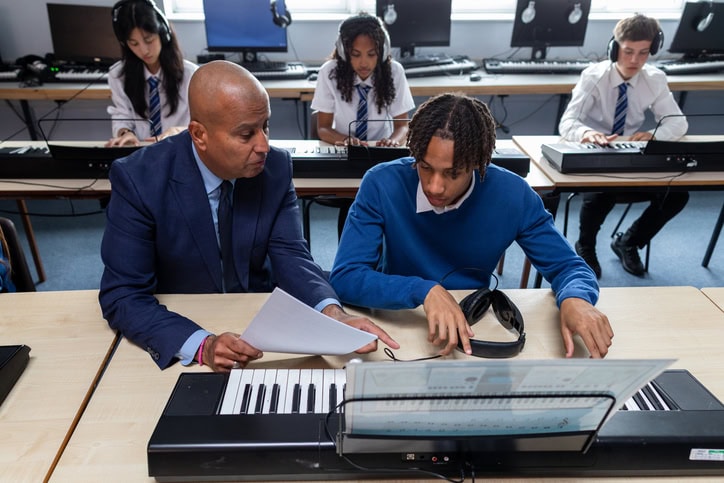
These heightened sensitivities require a neuro-inclusive environment where strategies are in place to support these students. For example, adjusting pacing provides additional time for a child’s muscle memory to develop. Some learners understand concepts before their body will be ready to demonstrate their comprehension.

Photo: FatCamera/E+ Collection via Getty Images
Calming strategies such as box breathing, positive affirmations, and connecting to the audience, a strategy supported by Anxiety & Depression Association of America, help reduce performance anxiety. These same strategies are also beneficial for students experiencing emotional dysregulation, a common comorbidity of giftedness according to the Journal of Intelligence. Modifying dynamic or volume levels is something many students benefit from, especially those whose brains are sensitive to sound, light, or touch.
Navigating Exceptionalities
Many gifted students are also twice exceptional, or 2e, meaning there is a co-occurring diagnosis such as ADHD, ASD, or anxiety. To meet these diverse needs, educators need an equally diverse tool bag of supports and strategies.
Gifted learners often grasp concepts quickly, which can lead to perfectionism. Rehearsals are centered around improvement and growth which can irritate a brain wired toward perfectionism. When the self-imposed goal is to be flawless the first time, falling short of that goal can cause some students to drop out or disengage from music. To combat this, look for the wins; find those micro moments where you can focus on the growth.
Students with ADHD often thrive in music because the novelty feeds their brain’s need for dopamine. In an elementary classroom, switch instruments or seats often, especially during repetitive activities. Challenge gifted learners to do something in lieu of not doing things by remaining actively engaged. It could be to hold mallets in a ready position or pass percussion instruments silently around a circle. For older students, perhaps the challenge lies in tuning the timpani as quietly as possible or asking them to hold an idea in their mind for three seconds before blurting out an answer to give their peers a moment to catch up. When your classroom is designed with neuro-inclusive practices, everyone wins!
While ADHD is common, it is not the only neurodiversity present in classrooms. NeuroSpark Health (2026) notes that Autism Spectrum Disorder, or ASD, can help brains recognize patterns, which makes games like Poison Pattern highly successful. However, missed social cues can make interaction-based games challenging. With patient peers, supportive strategies, and empathy, music classrooms can continue to be spaces where neurodiverse students thrive regardless of any potential challenges or diagnoses.
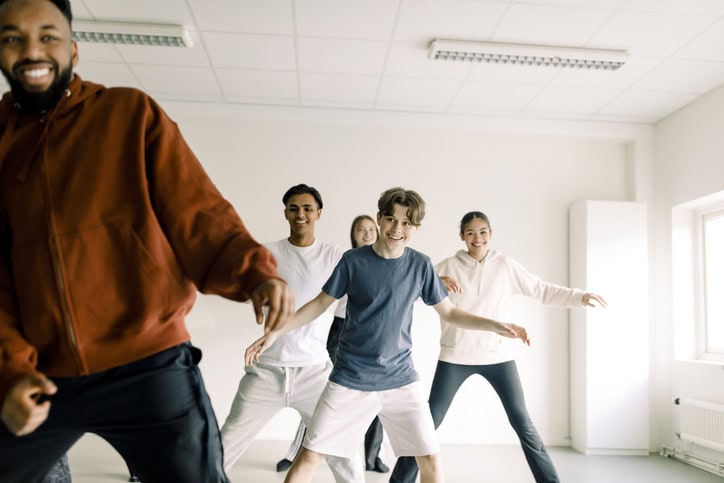
Photo: Maskot Collection via Getty Images
The M-U-S-I-C Strategy
Using the M-U-S-I-C acronym, I can be mindful to make sure music class includes everybody.
Movement: Non-negotiable routines and activities such as folk dances, scarf routines, and movement breaks help keep students regulated and instruments safe.
Unique: Novelty is a great way to boost engagement, especially for students with ADHD. Who’s to say that the introductory hook to your lesson cannot be a vibraslap or mooing like a cow?
Sensory: Noise-canceling headphones, dyslexia-friendly fonts, and flexible seating are just a few of the ways you can meet the sensory needs of your musicians in training.
Intention: Gamifying practice logs or having students “level up” when they meet a practice goal can provide the necessary framework for learning while giving students something to strive toward. My classroom features a “grand behavior” system in which each class works together to earn a musical game day each octave.
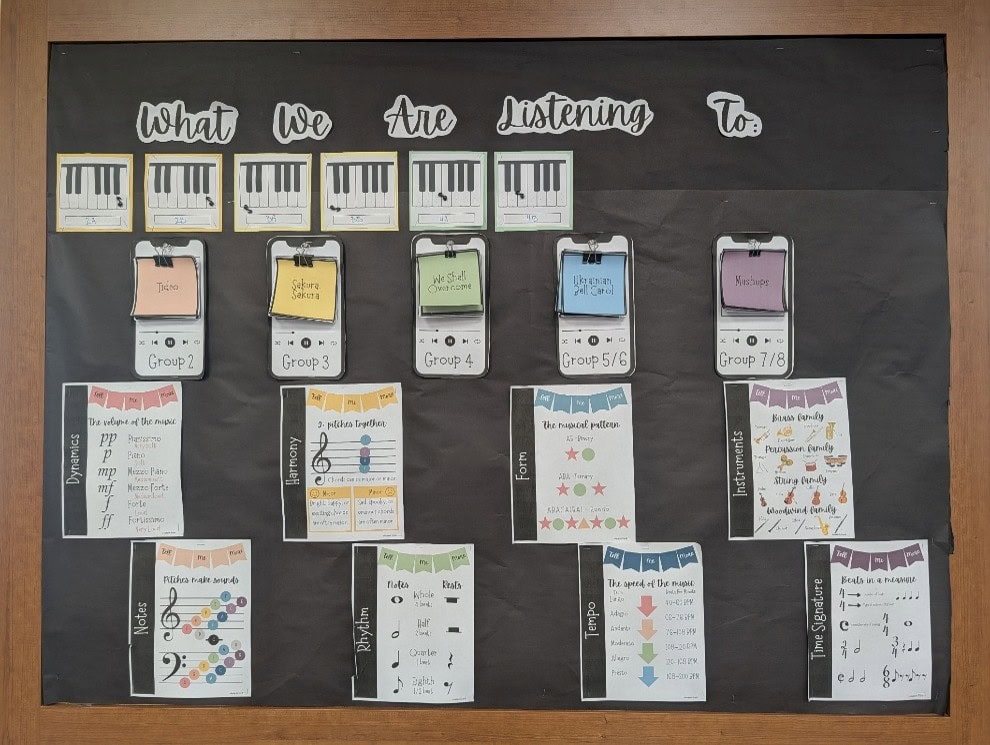
Image courtesy of the author
Communicate: Ensure instructions are clear, auditory, and visual. Humor can bring levity, but too much will muddle instructions.
Redefining “Success”
Cheryl Lavender once noted, “The fact that children can make beautiful music is less significant than the fact that music can make beautiful children.” In a neuro-affirming classroom, we must embrace the idea that success is as diverse as the students we teach. When we create healthy learning environments, students can feel safe enough to wear headphones during a concert as a sensory accommodation or willing to push past perfection paralysis to try something new. It has never been about the notes on the page but the music makers themselves.
About the author:
 NAfME member Jaime Surdynski is a music educator at The Avery Coonley School in Downers Grove, Illinois, where she directs two vocal ensembles and teaches elementary and middle school music. In her 15+ years of teaching gifted students, she has designed and implemented a school-wide curriculum to meet the needs of neurodivergent learners. Jaime is a TedX speaker and has earned her school the NAMM’s Best Community for Music Education Award for nine consecutive years. When not involved in music, Jaime volunteers at her local animal shelter and fosters dogs.
Did this blog spur new ideas for your music program? Share them on Connect! Interested in reprinting this article? Please review the reprint guidelines.
The National Association for Music Education (NAfME) provides a number of forums for the sharing of information and opinion, including blogs and postings on our website, articles and columns in our magazines and journals, and postings to our Connect member portal. Unless specifically noted, the views expressed in these media do not necessarily represent the policy or views of the Association, its officers, or its employees.