NAfME BLOG
Level-Up Student Agency

How to Do Less for Your Students So They Can Do More!
By NAfME Member Erin Zaffini
My oldest son is in his final year of middle school this year. And, like many kids his age, he has lots of homework and does (way too many!) things outside of school. At the moment, it’s cross-country and karate. A true sports kid. Much to my (happy) surprise, he’s recently been bitten by the musical theatre bug. 🙂 This fall, he landed his first big role—a huge accomplishment that he’s both nervous and thrilled about.
As exciting as it is, I’ll admit I’m worried about how he’ll juggle it all. Between school, sports, and now rehearsals, I keep finding myself trailing after him around the house asking things like: When are you going to start memorizing your lines? How about we run through the scenes together? Should we make a schedule for at-home practice?
At first, he tolerated my constant reminders, but eventually he stopped me mid-question and said, “Mom, I’ve got this. I’ll let you know when I need your help.”
It was one of those parenting gut-check moments. As much as I want to swoop in and make sure everything gets done, he’s right—he can do this. He’s capable of managing his own responsibilities, and he knows when to reach out if he needs me.
And you know what? The same dynamic shows up in our music classrooms. Simply put—we do too much for our students. As teachers, we often hover, prompting, reminding, and sometimes even doing too much of the work ourselves.
And yes, there is a time and place for that. Students need to be taught to be more self-sufficient, and that does take time. But if we step back and give students more opportunities to practice taking ownership—while making sure they know support is there when they need it—we help them grow into more confident, independent musicians. Wouldn’t that be wonderful?!?
That’s the heart of student agency. It’s about letting them take the wheel in manageable, intentional ways while we walk alongside as guides.
So, what does student agency actually look like in our music classrooms?
Check out my top six recommendations on how you support these skills with your students. If this is new to you, I recommend trying one or two new strategies during a school year consistently. This way, you can refine, tweak, and really help your students develop these new skills over time.
-
Keep Goals Firm, but Pathways Flexible
Make the learning target crystal clear—say it out loud, write it down, keep it visible. Then, instead of dictating the one way students must show mastery, offer a few options. Better yet, ask them for suggestions.
Want them to demonstrate understanding of a musical concept? Give them a menu to choose from:
- Write an explanation
- Record a short video
- Perform something live
- Create a drawing or diagram
- Team up for a podcast
Keep expectations high, but let students decide how to meet them. Pro tip: Don’t offer too many choices at once. This can become overwhelming for many students. Three or four well-thought-out options are usually plenty.
-
Try Jigsaw Teaching
Instead of teaching every concept yourself, let students become the experts. Give small groups one element of the lesson to learn deeply—say, musical form, tempo, or dynamics—then have them prepare a mini-lesson to teach their peers.
When the groups come back together, each “expert” brings their knowledge to the table, and suddenly, students are teaching each other while you circulate, give feedback, and fill in the gaps.
If the idea of handing over so much feels daunting, ease into it by making one of your learning stations a “teach the teacher” station. Students practice explaining their part to you before they share it with classmates.
-
Build in Quick “Openers” and “Closers”
Want to know what your students are thinking, where they’re struggling, and how to adjust your teaching in real time? Start and end class with quick check-ins.
For openers, try prompts like:
- “One skill I need more feedback on is ___ because ___.”
- “Today I expect to learn about ___ because ___.”
For closers, try:
- TILT (“Today I learned that…”)
- The 3-2-1 Method (3 things learned, 2 connections made, 1 question left)
- “One thing that worked for me today was ___ because ___.”
Even a two-minute reflection can give you (and them!) clarity about what’s working and what needs more attention. Note: An opener or a closer should not take more than 5-7 minutes of class time, so find a way that works for you in your specific teaching context.
-
Rotate Student Leadership Roles
In ensembles or group music-making, try assigning rotating roles like “section leader,” “conductor for the day,” or “rehearsal planner.” These roles don’t need to be high-stakes—they can be as simple as leading a warm-up, keeping rehearsal on track, or suggesting strategies when a section gets stuck.
When students get a chance to lead, they develop confidence and learn to listen differently—as both contributors and decision-makers. It’s amazing how a small leadership opportunity can change the way a student engages with music.
-
Invite Students into the Repertoire Process
Instead of always handing out the next piece, ask for student input. This doesn’t mean you give up your professional judgment—students may not always know what’s pedagogically appropriate—but you can invite them to suggest genres, themes, or even specific songs they’d love to play.
Maybe they vote on one piece in a concert set, or bring you “wish list” ideas that you adapt into ensemble arrangements. This simple step gives students ownership of the music they’re making and creates a powerful sense of connection to the repertoire.
-
Use Choice Boards
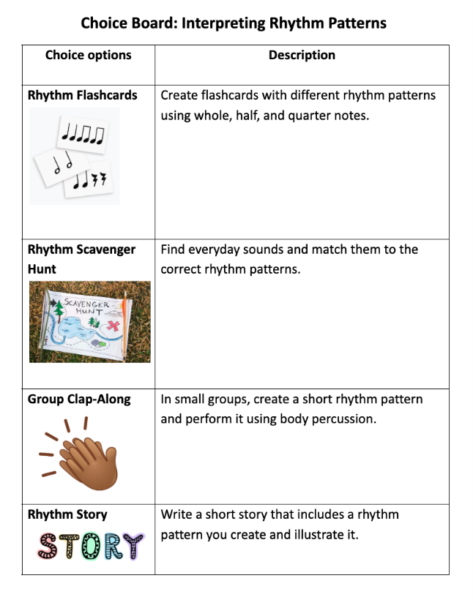
Choice boards are one of the simplest ways to hand more decision-making over to your students without overwhelming them. Picture a tic-tac-toe grid (or a simple 3×3 table) where each square has a different task or activity. Students choose three in a row—or whichever number you set—to complete.
For example, in a music class choice board you might include:
- Write new lyrics to a familiar tune
- Record yourself explaining a rhythm pattern
- Create a movement sequence that matches a piece of music
- Interview a peer about their favorite genre
- Draw a visual map of a song’s form
Choice boards balance structure with freedom: You set the boundaries, but students get to decide their path. They’re especially powerful because they allow for repetition of skills while honoring different learning preferences.
Check out a downloadable sample choice board here—feel free to use it with your own classroom!
One Final Thought
Fostering student agency and autonomy in our classrooms takes patience and practice (for both teachers and students!). None of this requires a complete reinvention of your teaching, but it does require a commitment to small changes over time. Whatever you choose to do to promote agency, make sure it works with you and your students. As I say to all the music teachers I have the pleasure of coaching, context really drives the ship. Not every student is ready for multi-step directions that often accompany more complex opportunities for choice. You might not have the luxury of your own classroom where you can post choice boards on the walls regularly, or a block schedule that allows time for both an opener and a closer daily. If you are trying something and you find it’s just not working after a few attempts, move onto something else. As with any new strategy, if it’s not practical, it won’t stick. Simple, realistic, and consistent changes—that’s the key to helping your students feel trusted, capable, and motivated, because you’ve taught them that they’re capable of doing more of the work themselves.
Cheers to you and all the amazing things you do!
About the author:
 NAfME member Dr. Erin Zaffini is an internationally recognized music and arts education speaker, consultant, clinician, mentor and instructional coach. She serves as Assistant Dean of Teacher Education at Longy School of Music, where she directs online Master of Music Education and Certificate of Advanced Graduate programs, graduate courses, and summer professional development.
A former PreK–8 general, choral, instrumental, and musical theater teacher, Erin is an active clinician and mentor worldwide. She has held leadership roles with NAfME, the New Hampshire Music Educators Association, and currently facilitates NAfME’s Supporting Beginning Music Teachers initiatives. She also coordinates mentoring for the Massachusetts Music Educators Association and leads music educator mentor training for across the country.
Honored with Keene State College’s Excellence in Teaching and Performance Awards, Erin has published in General Music Today, Music Educators Journal, Qualitative Research in Music Education, and Update: Applications of Research in Music Education.
Visit her website and connect on LinkedIn. Learn about Longy School of Music’s Online Master of Music Education, Online Certificate of Graduate Studies, and online graduate courses.
Did this blog spur new ideas for your music program? Share them on Connect! Interested in reprinting this article? Please review the reprint guidelines.
The National Association for Music Education (NAfME) provides a number of forums for the sharing of information and opinion, including blogs and postings on our website, articles and columns in our magazines and journals, and postings to our Connect member portal. Unless specifically noted, the views expressed in these media do not necessarily represent the policy or views of the Association, its officers, or its employees.