NAfME BLOG
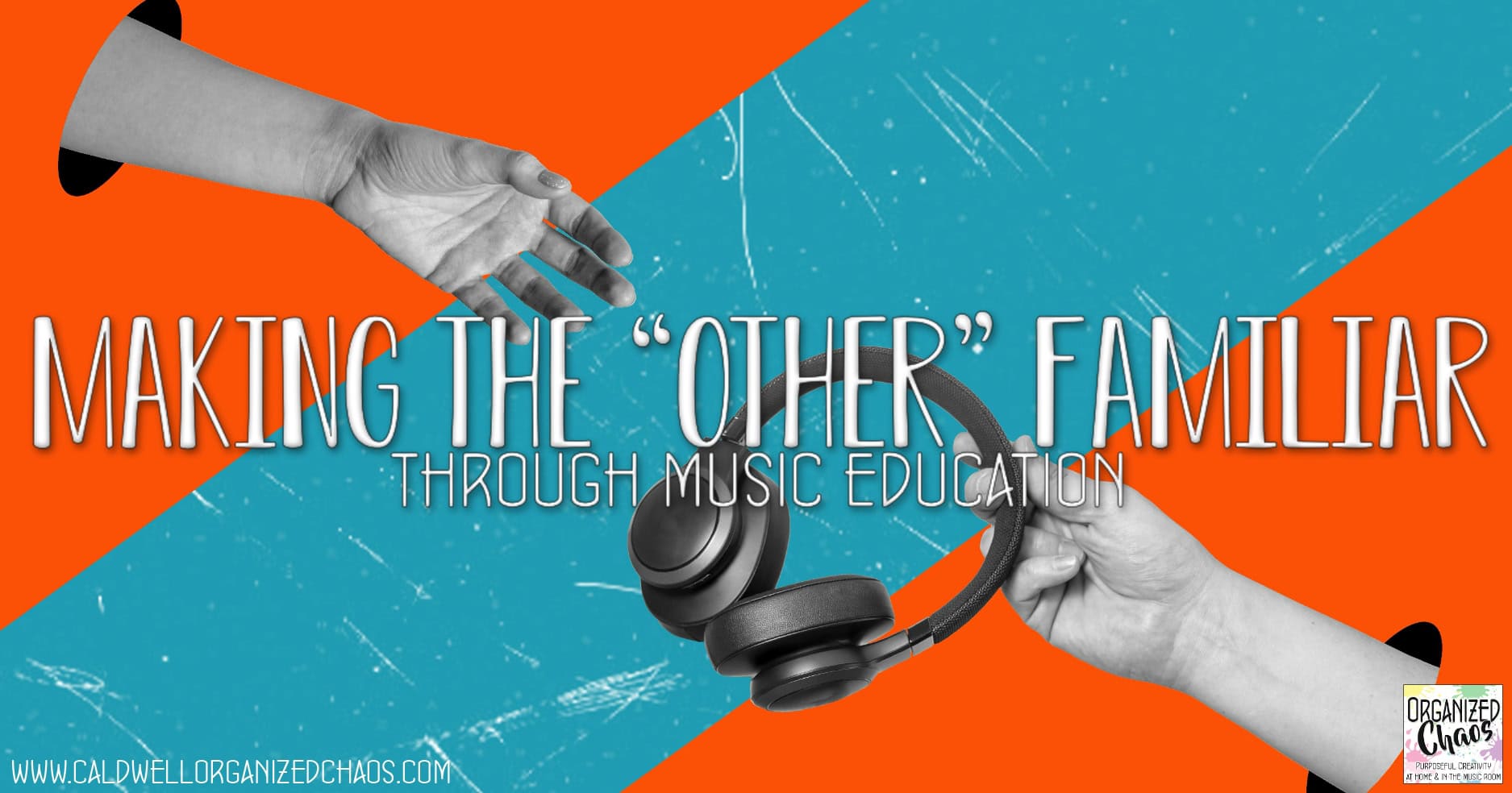
Making the “Other” Familiar Through Music Education
Making the “Other” Familiar Through Music Education
By NAfME Member Elizabeth Caldwell
The original article first appeared on the Organized Chaos blog.
I believe one of the most important roles we play as music teachers is bringing the world to our students—giving them a language to connect with more people and giving them experiences that make the “other” less foreign, more familiar. I think most music teachers agree, but many struggle with how to do so effectively, or feel overwhelmed by the enormity of the task. Here are some of my thoughts on how to make your classroom a place that fosters empathy through opportunities to connect with a broader range of perspectives.
First a little about me, because my background has definitely shaped my perspective on this. I grew up across three continents, mostly living outside my passport country until college, spent the better part of the first decade of my teaching career in international schools, and since then have taught as a white teacher in a primarily non-white, low-income population school in the United States. I became a music teacher because of my experience moving to schools as a child where I did not speak the language and finding a place where I could participate in the music room.
Normalize, not exoticize
I think the most important thing to keep in mind that will be the difference between sharing unfamiliar music in a way that is harmful vs. helpful is to remember the goal is to normalize, not exoticize. Exploring new perspectives and ideas should be exciting, but we should present them as new to us, not new to the world, different from us, not unusual or different from the “standard.” I’ve written an entire post on how to do this concretely here, especially as it relates to cultures around the world, but I think the most important aspect of this practice is to both use songs from a wide range of cultures, languages, and genres in your everyday lessons when the background of the song is not the main point of the lesson, and also spend time doing a deep dive into some specific genres, cultures, and perspectives to give students a deeper understanding of the context.
Watch your language
Be careful with the word “we/us.” Who is “we”? And this may seem obvious, but be very careful with the word “normal/ standard.” What is “normal”? This is really at the heart of how students understand what is “other.” No matter how positively it is presented, if a genre, culture, or people group are presented as “unusual” or “not us,” it is by definition being “othered.” Instead of presenting a new idea or perspective in a “we vs. them” or “normal vs. unusual” way, present it as additional information. Instead of “we use the violin, but China uses the erhu,” try “we learned about the violin last year, and today we’re going to learn about another instrument called the erhu,” for example.
Focus on transferable skills
One of the biggest setbacks for teachers I talk to is feeling like to do it right, they need to make sure to include every culture, every perspective, equally. While broadening our materials by adding more different perspectives is definitely important, it’s also important to remember that the skills students gain from interacting with a new perspective will transfer. The same way that teaching students to read and perform one song with quarter notes will allow them to learn more songs with quarter notes, the skills of cultural navigation and empathy will transfer to new perspectives and cultures they encounter outside your classroom. So, focus on giving students the opportunity to interact with and understand new perspectives rather than making sure you include every perspective that exists.
Learn from the source
Hopefully this goes without saying but you can’t expect to learn about Japanese music from a Kodály song collection compiled by a white American who “learned it from their levels instructor” (it makes me angry just typing that because I’ve heard it so often). Certainly those types of resources can serve as starting points, but before you present it to students, it’s important to trace it back to a native source. The same goes for anything on my website! I try, when it is not something from my own personal background, to include my native sources in the articles I share. I encourage you to go back to those and learn from those sources, not just directly from me—that is the point! If you see a song that is labeled as “from” a certain country, but you can’t find any source from that country referencing the song, there’s a good chance it’s not from there. Here are a few examples of commonly circulated songs that are actually American, not from the cultures many books and presenters claim they are from. Learning directly from a native source will also give you important context that you will most likely miss out on otherwise. I have been learning a lot about hip-hop since moving to the United States, but it wasn’t until I had the opportunity to speak with hip-hop artists themselves and share with them the lesson ideas I was working on, that I gained an understanding of important context that I needed to include in my lessons. Even when people are sharing directly from culture bearers themselves, they are sharing the parts that they learned, not the entire picture. You need to always go back to the source.
There is certainly a lot more to be said on this topic, but these are the most important points I think to keep in mind to move further down the path of creating an equitable, inclusive classroom that brings the world to our students. If you are looking for a place to learn more about how to do this effectively, and find materials, ideas, and resources from culture bearers to add to your teaching, I’ve created a page on my website called Music Education Equity Resources where you can search by country, language, genre, and more topics to find resources to use in your classroom. And if you want to see a (regularly updated) full curriculum that seeks to put these ideas into practice, I have published my K-6 general music curriculum here.
About the author:
 NAfME member Elizabeth Caldwell has been teaching elementary general music and choir for over a decade and cannot imagine ever doing anything else. She is also the author of the website, Organized Chaos Music, where she regularly shares organization strategies, lesson plans, and other ideas to encourage purposeful creativity in the music classroom. She holds her B.M.E from Wheaton College (Illinois) and her M.M.E. from Boston University and was named Teacher of the Year in 2018. She has presented on lesson planning, restorative behavior management, effective recorder teaching, world music, National Core Arts general music standards, and other music education topics at conferences around the globe and teaches an e-course on lesson planning through her website.
Follow Elizabeth on Facebook, Instagram, Twitter, YouTube, and Pinterest.
Did this blog spur new ideas for your music program? Share them on Connect! Interested in reprinting this article? Please review the reprint guidelines.
The National Association for Music Education (NAfME) provides a number of forums for the sharing of information and opinion, including blogs and postings on our website, articles and columns in our magazines and journals, and postings to our Connect member portal. Unless specifically noted, the views expressed in these media do not necessarily represent the policy or views of the Association, its officers, or its employees.