NAfME BLOG
From Sound through Soma to Symbol: A Friendly Reminder
Centering the Body in Music Education Settings
By NAfME Member Laura Montanari
Every year I cross the border, it’s the same—my mind forgets. But my body always remembers.—Sandra Cisneros, Caramelo
The secret has been out for a while. Students of all ages benefit from internalizing musical sounds before encountering the symbols that represent them. Only after embodied experience can students truly understand and reproduce Guido d’Arezzo’s secret codes, now commonly called “music notation.” Dalcroze, Kodály, Orff, and countless theorists and scholars have advocated for the centrality of the body in music teaching and learning, not only to process and internalize rhythm and pitch, but more so to develop the fluidity and ease that characterize so many aspects of one’s musicianship.
by Marta Pilosio
(opens in new tab)It should come as no surprise, then, that many cultures have preserved the idea that music and dance are semantically intertwined, especially across African diasporic traditions. Case in point: I often guide my students to notice that salsa and samba are genres, rhythms, and dance styles all at once—each extremely groovy, perhaps for the very reason that the body is central to the music’s execution. Or, so many of the genres we love have movement embedded in their very names: Swing, Rock, Hip-Hop.
Pre-service teachers readily welcome the “sound-before-symbol” approach and the many strategies employed to facilitate an intuitive, unmediated experience of sound at the heart of our music pedagogy. After all, aren’t we all in this because of sonic experiences? As music appreciators, we loved sounds the most. They caught our attention, perhaps at a very young age, and connected us to the sublime and poetic dimensions of our being. Sounds moved us. And moved us. And yet, we don’t move as much as we should—or could.
Andante con Moto
When I am in the field supporting our brilliant clinicians whose energy is ready to spread joyful musical experiences, I often notice that this does not always translate easily into praxis given the way we have been conditioned to conceptualize (and accept) musical experiences shaped by the Western canon, especially in secondary schools, band, or choral settings. Unfortunately, this disconnect is not confined to those settings; it can often be encountered even at the elementary level or across general music classrooms, as the music education field has often been “reducing musical learning to a process of acquiring technical and theoretical knowledge, in which the body is little more than a tool that is trained to perceive and perform ‘correctly’” (van der Schyff, Schiavio, & Elliott, 2022, p. 157).
by Marta Pilosio
(opens in new tab)Too often, classroom designs and space constraints do not support kinesthetic and spatial exploration. I know this all too well as I taught from a cart for several years in very small rooms. Still, we can be more creative than the system allows. Indeed, many music teachers strive to incorporate “movement with a mission” (Campbell, 2018, p. 48)—the one Dalcroze had in mind for his conservatory students—into their work to help students develop a thorough musicianship. We can never forget that our students are “creative musical bodies” (van der Schiff, Schiavio, & Elliott, 2022, p. 138).
I often ask my pre-service students: “The body! Where is the body?” Clapping can embody rhythm, but it might not be enough for all students. The body is capable of more energy and fluidity than a single limb can show (and we all see it in the energy that our students need to liberate and express). Further, in large-ensemble settings, instrumentalists might struggle to hear other sections or appreciate how their parts relate to one another. Even a simple student-generated body-percussion arrangement could lead to a flawless, expressive rendition of intricate counterpoint parts, expanding students’ accuracy and even listening skills.
Teachers Move Mountains
One day, I observed the amazing New Jersey-based band teacher Ms. Sarah Santana during her clinical training. She seemed puzzled as she watched her elementary band students struggle to perform a simple call-and-response rhythm between two percussion sections in the ensemble. One section was supposed to play two eighth notes. At the same time, other percussion instruments were expected to respond with a quarter note—the very basic rhythm we teach through countless elementary general music songs. They should have known it; she knew they knew it. And yet, something was not working. The eighth notes lacked momentum, energy, and a clear tempo for the rest of the band. The response consistently emerged late and lacked confidence.
by Marta Pilosio
With the grit that only teachers possess when they are determined to accomplish something with and for their students, this Maestra asked them to all stand up. The kids initially thought it was some sort of punishment—why stand up when sitting down seems customary? Ms. Santana was quite serious, but I knew the light in her eyes by heart. She possessed the look of a teacher when a lesson plan did not unfold as planned, and a solution had to be found on the spot. She asked them to stomp their feet to the eighth notes and clap the quarter notes. Naturally, they all began to sing “We Will Rock You” by Queen. As the mentor teacher in the room, I could not help but join!(opens in new tab)
What happened? The students smiled, thinking it felt both odd and fun. (The following year, they would be middle schoolers, so imagine their awkward movements.) The room’s energy shifted: Even though students knew they hadn’t practiced enough or couldn’t yet play the music, they looked happier. And you likely have guessed it by now: They executed the rhythm correctly, with intention and groove.
When the execution of musical notation fails, perhaps we haven’t done enough. Clapping is a step, but the whole body can shape the overall performance with groove, energy, intention, and expressivity. The energy needed for a meaningful, musical execution can be (re)activated through whole-body engagement. Those students knew the rhythm cognitively, but they were not yet able to embody it musically.
No Broken Records in Music Education!
I have been reflecting ever since on the fallacy of the “sound before symbol” phrase. Those broken-records slogans we use in our field that do not lead to actual praxis can be quite detrimental. At times, we end up referencing them or putting them on the board to show we are up to date with our professional homework, but, in all honesty, with little change in our classroom practices. When this happens, perhaps we should question the very words we use before they are emptied of their semantic and historical importance.
For this reason, I propose this new phrase—from sound through soma to symbol—which I hope will become actual praxis, unlike its predecessor. By affirming the body’s essential role and being cognizant of its central importance, I hope the field will begin to stop neglecting or easily bypassing it in our pedagogical practices because “this is not the way it’s usually done,” or, even worse, because we do not feel comfortable. How can we ask our students to perform music on new instruments that might feel uncomfortable for many if we are not willing to feel uncomfortable trying something new, too?
by Marta Pilosio
(opens in new tab)Moving on, we might need an additional box across our lesson plans and unit plans: Bodily engagement. I stress this to pre-service teachers: “This is not about you or me. This is about what is best for most of your students. Backed up by research, in case someone takes the liberty to question your pedagogical choices!”
One way to hopefully achieve this? Once the body is involved—truly involved—there is no reason (or time) to say anything. We are the sound when we react to it, physically and emotionally, moving in both senses. We engage in making music before considering it a strategy, allowing some musical understandings to emerge through the body rather than treating cognition as something that happens independently of the body.
From the outside, we might look at students’ physical responses as a helpful tool for demonstrating what they know. But their embodied actions are part of the learning process—part of how they came to know in the first place—a friendly reminder of “the central role the body plays in driving cognitive processes” (van der Schiff, Schiavio, & Elliott, 2022, p. 122). In those moments, speaking and explaining (read: re-teaching) can become redundant.
Why Soma?
I preferred the word soma to other terms in the same semantic field (e.g., body, embodiment, embodied cognition, kinesthetic intelligence, movement) because of its assonance. Shusterman (1999) introduced somaesthetics “as the critical, meliorative study of the experience and use of one’s body as a locus of sensory-aesthetic appreciation (aisthesis) and creative self-fashioning” (p. 302), an important definition for us in the creative arts to keep in mind.
Italian psychiatrist and psychoanalyst Vittorio Lingiardi (2024) reflects on Winnicott’s concept of psyche-soma, understood as a constellation of experiences that cannot be located in the body nor in the brain, because the psyche is where the soma dwells (in fact, Winnicott coins the term indwelling): “The body, too, is mind, not only the brain” (p. 17). Lingiardi connects Winnicott’s idea to James Grotstein’s neologisms of mindbody or bodymind and helps us notice that
the body is not merely the non-mental or the non-psychic aspect of the self; rather, it is the alter ego of the mind, a sort of “second self,” which speaks in its own personal language, but is always part of a “Siamese twinship.” The mind-body is one, even though they may appear to be two. (p. 16)
by Marta Pilosio
The ongoing conversations around embodied cognition in education have found enthusiastic resonance among music education scholars, as musical meaning-making is quintessentially embodied: movement, feeling, and cognition are deeply interconnected in the magic we call music. More than 20 years ago, Bowman (2004) urged us to consider that
we recognize the profundity of the somatic/corporeal moment in human cognition, generally, and that we recognize music in particular as a kind of special celebration of this moment—of our here-and- now, embodied, action-based mode of being. Foremost among the reasons music truly matters educationally is its participatory, enactive, embodied character—and its consequent capacity to highlight the co-origination of body, mind, and culture. (p. 46)(opens in new tab)
P.S. But No Acronyms, Please!
As I was writing this article, I used the title “SSS” for short. I want to urge us not to fall into the trap of acronyms, as we often forget what each letter stands for. (Try this with your students: What does OK stand for?) I argue this as someone who speaks a Romance language, which, by design, tends to articulate its words fully. The acronym could bring us back to forgetting the centrality of the kinesthetic component and bodily engagement, something that our lifestyles surely tend not to favor. We need to be honest with ourselves: We are becoming increasingly sedentary, and our kids spend too much time in front of devices rather than playing outdoors in the streets or enjoying sports and dance, as previous generations did.
by Marta Pilosio
One example: In her eye-opening article “A sound-to-symbol approach to learning music,” Jordan-DeCarbo (1986) does not mention the words body and kinesthetic, while the word movement appears once toward the end while referencing the Dalcroze approach: “The rhythmic language, however, is generally associated with note values and in the early stages relates to (opens in new tab)movement—walking (quarter notes), running (eighth notes)” (p. 41).
This is a reminder that we must say it out loud! Words matter as they shape the reality we create. If we already struggle to center the body and truly engage it in our life and pedagogy, then we need the full reminder. I hope you will write this at your desk or somewhere in your classroom: from sound through soma to symbol. Or even simply sound-soma-symbol. Whatever form you choose, move and have fun!
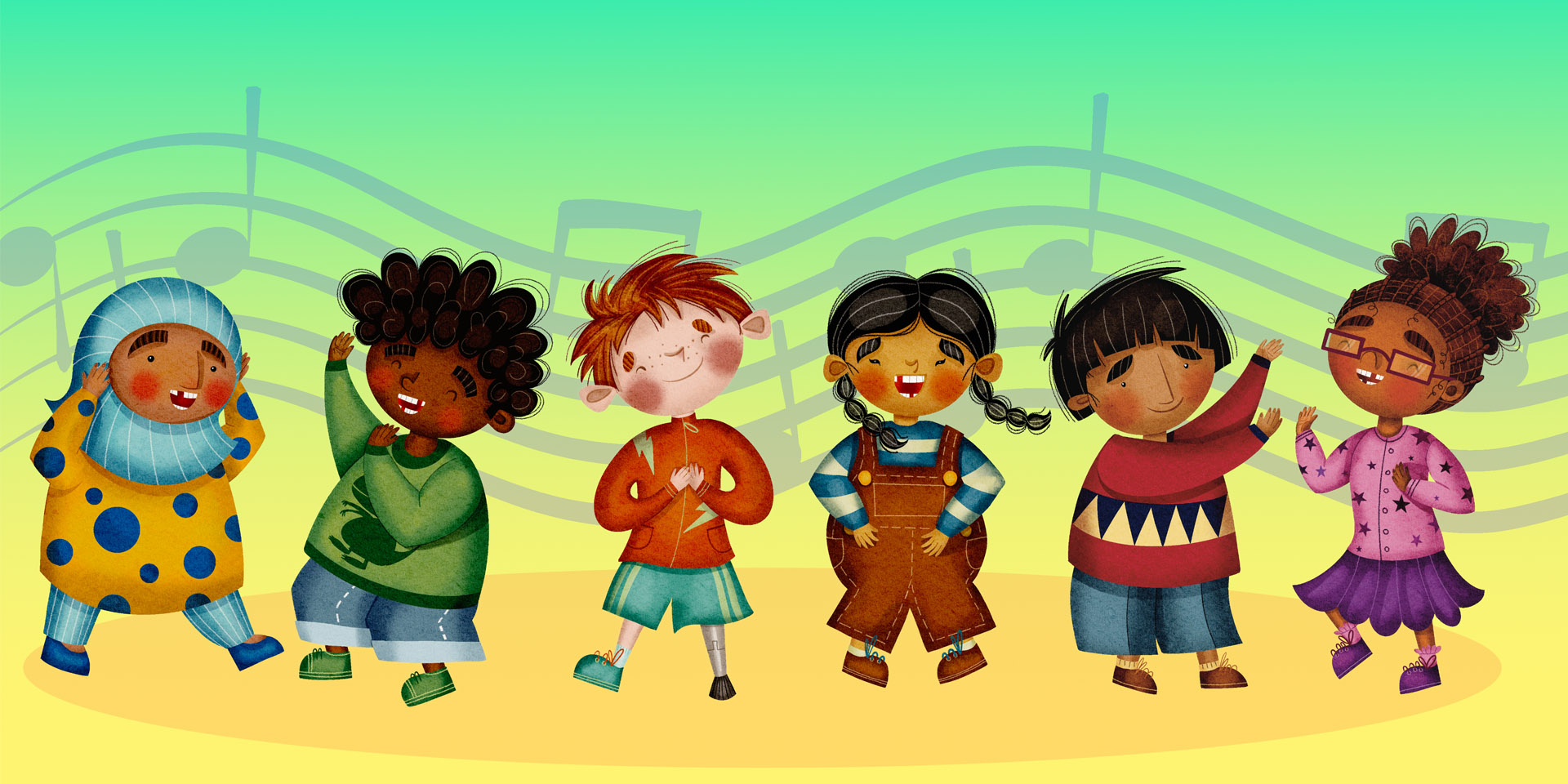
Illustrations at the top and throughout article by Marta Pilosio.
References
- Bowman, W. (2004). Cognition and the body: Perspectives from music education. In L. Bresler (Ed.), Knowing bodies, moving minds. Towards embodied teaching and learning(opens in new tab). Springer Dordrecht. (pp. 29-50).
- Campbell, P. S., & Scott-Kassner, C. (2018). Music in childhood. From preschool through the elementary grades. Cengage Learning.
- Jordan-DeCarbo, J. (1986). A Sound-to-symbol approach to learning music. Music Educators Journal, 72(6), 38-41.
- Lingiardi, V. (2024). Corpo, umano. Einaudi
- Shusterman, R. (1999). Somaesthetics: A disciplinary proposal. The Journal of Aesthetics and Art Criticism, Vol. 57, No. 3, 299-313.
- van der Schyff, D., Schiavio, A., & Elliott, D. J. (2022). Musical bodies, musical minds. Enactive cognitive science and the meaning of human musicality. MIT Press.
About the Author
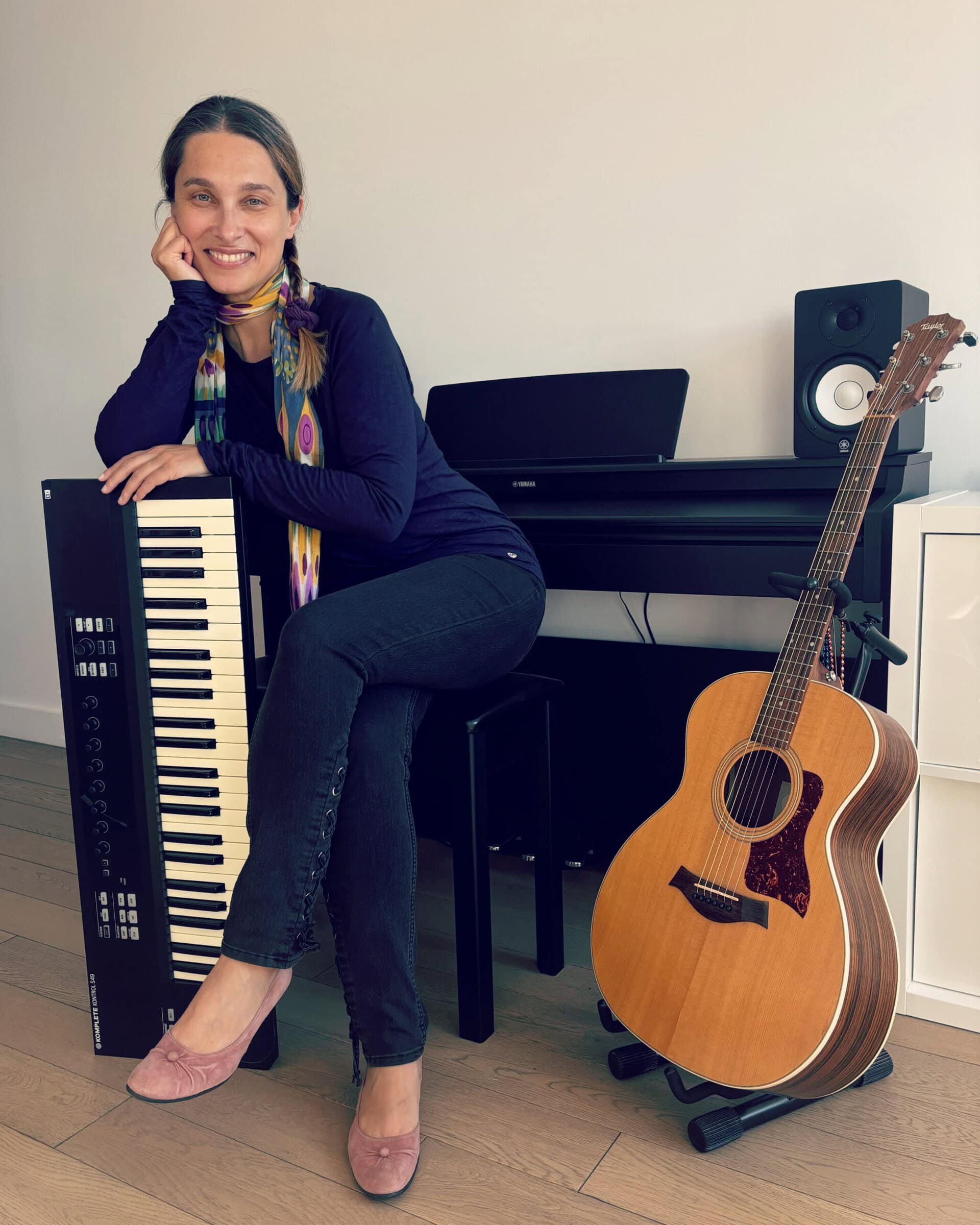
Photo by Valentina Lombardi
NAfME member Laura Montanari, Ed.D.(opens in new tab), is a singer/songwriter and music educator from Umbria, Italy. Her research focuses on embodied ways of learning and the relationship between songs and history, specifically how songs can serve as primary sources that can reveal diverse cultural perspectives and non-hegemonic historical discourses.
Dr. Montanari teaches music education at Montclair State University and Teachers College (Columbia University). She also teaches Music & Movement for Classroom Teachers at Bank Street College of Education, Songwriting at NJIT, and Social Studies & the Arts at Montclair State University.
In 2022, she published Let’s Make Our Sound, a children’s book based on her eponymous children’s song, while in 2024 she released “That’s My Song,” a series of songwriting notebooks. Her original music is published under the pseudonyms Larthia and Cupra:Ring.
Visit Laura Montanari’s website(opens in new tab).
Did this blog spur new ideas for your music program? Share them on Connect! Interested in reprinting this article? Please review the reprint guidelines.
The National Association for Music Education (NAfME) provides a number of forums for the sharing of information and opinion, including blogs and postings on our website, articles and columns in our magazines and journals, and postings to our Connect member portal. Unless specifically noted, the views expressed in these media do not necessarily represent the policy or views of the Association, its officers, or its employees.