NAfME BLOG
The Song Remembers
What Teaching Music Alongside Dementia Teaches the Teacher
By NAfME Member Dr. José Valentino Ruiz
There is a moment every music educator should experience at least once: sitting in a circle with people whose memory of nearly everything else has grown thin, and watching a melody find a pathway that names and dates cannot. I carry a deep professional interest in this space through my research translation work in arts and health, as co-founder and Chief Research Officer of Aravine LLC and as an Associate Member and Research Collaborator with IC3 at the UF College of Medicine. What follows is not a clinical claim and not a prescription. It is a reflection from an educator’s vantage point, offered with humility, about what happens to your pedagogy when the goal is not achievement but presence.
Personhood Before Performance
Picture it, because this picture will teach you something no method book can. You are in a room where no one auditioned to be there and no one will be graded when the hour ends. A melody begins, maybe an old hymn, maybe a song from a radio long gone quiet, and something in the room changes. Posture straightens. A voice you have not heard all afternoon joins in, unsteady but certain. No rubric measures this. And yet you know that something real has happened.
The first lesson is about personhood. Tom Kitwood argued that prevailing approaches to dementia had reduced people to their neurological diagnosis, and he proposed instead that personhood, a standing bestowed upon one human being by others in the context of relationship, should be the central concern of care (Kitwood, 1997). Read that sentence as a teacher and let the ground move beneath you.
Most of music education is organized around measurement. We count what a student can do: the chair earned, the part mastered, the grade achieved. None of that is evil, and much of it is useful, but it is scaffolding, and scaffolding is not the building. In a room with people living with dementia, the scaffolding falls away, and what remains is the older, deeper truth underneath it. Music made together is a relationship before it is an accomplishment. The song is not the product of the meeting. The meeting is the product.
Kitwood’s framework hands you a question that deserves to follow you into every classroom you will ever teach: Am I treating this person as a performer to be evaluated, or as a person to be met? You are never just a teacher. In that circle you are also a witness, a host, a fellow traveler, and the people across from you are never just participants. They are persons, and personhood is not something you assess. It is something you honor.
Photo: Nina Borisova/iStock/Getty Images Plus
Wonder and Caution
The second lesson is about honesty, and it matters because this is a space where good intentions are not enough. The research literature on music and dementia deserves your careful attention, not as ammunition for a grant proposal but as a discipline of the mind. A Cochrane review of music-based therapeutic interventions for people with dementia examined outcomes including emotional wellbeing, mood, behavior, social behavior, and cognition (van der Steen et al., 2018). A 2025 update to that review continued the inquiry while explicitly noting uncertainty in the evidence (van der Steen et al., 2025). I cite this to model the posture I want you to carry into every room: interested, hopeful, and rigorously honest.
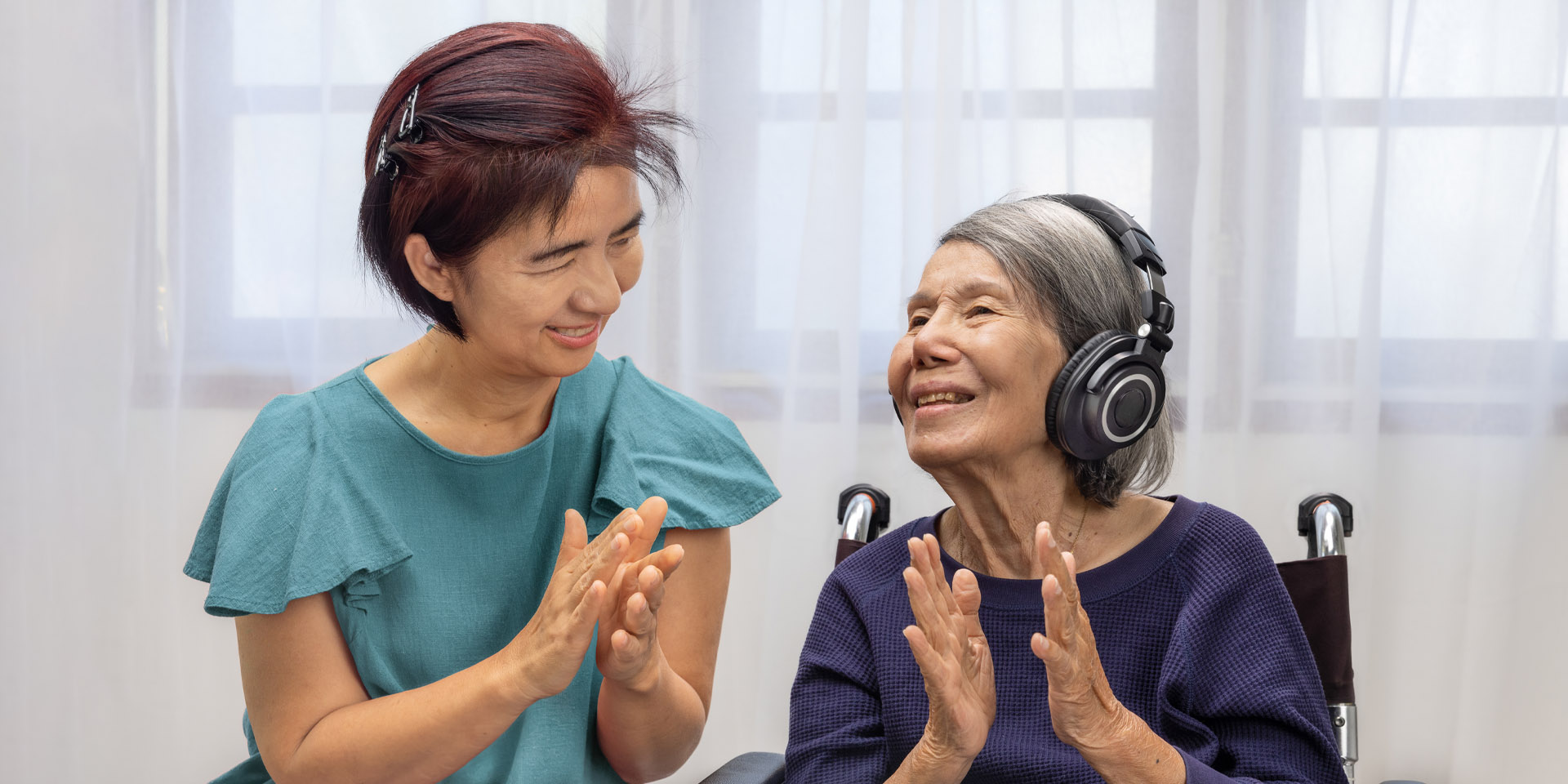
The cultural touchstones matter here too, because they have shaped what families and the public expect. The documentary Alive Inside brought these questions to millions of viewers and won the Audience Award at the 2014 Sundance Film Festival (Rossato-Bennett, 2014). Organizations like the nonprofit Music and Memory, founded by Dan Cohen, have built their work around personalized music playlists for older adults (Music and Memory, n.d.). It is right to be moved. But our job as educators is to hold both the wonder and the caution at the same time: Music can be profoundly meaningful in these rooms, and meaningful is not the same as proven.
That distinction leads to the third lesson, which is about roles. Music therapy is a credentialed clinical profession with its own training, ethics, and scope of practice. Music education is something different. We are teachers of musical relationship, not clinicians treating symptoms, and blurring that line does a disservice to both professions. When I make music alongside people living with dementia, I am not delivering therapy. I am practicing the thing I have always practiced: creating the conditions for people to meet each other through sound. The setting changes what that requires of me, but it does not change what it is.
So do not improvise your way into clinical settings. Partner with care communities, learn from credentialed music therapists and gerontology professionals, and let the people living with dementia and their families teach you what respectful practice looks like. The educator’s gift to this space is not expertise about dementia. It is expertise about music as a human meeting place, offered humbly, in service of personhood.
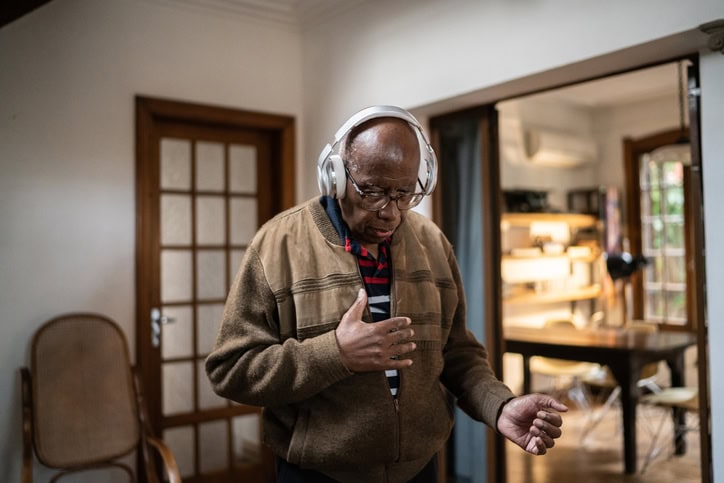
Photo: FG Trade/iStock/Getty Images Plus
The Presence Session
Here is where reflection becomes practice. I have started calling the shape of this work The Presence Session, and it is not a lesson plan in the usual sense. There is no objective on the board, no assessment at the end, no repertoire list to conquer. It is a framework for how you prepare, how you play, and how you reflect. Before, during, and after: Each movement asks something different of you, and each one will make you a better teacher everywhere else you teach.
Before the session, you prepare your presence. That phrase sounds strange to a profession trained to prepare content, but in this room your preparation is mostly interior and relational. Learn the names of the people who will be there, said the way they like them said. Arrive early enough that you are settled before anyone else has to be. Consult the care staff, because they know things you cannot know: who had a hard morning, who lights up at a particular song. Ask families or staff about the music that has mattered in these lives, because a song from a wedding dance in 1962 is not repertoire, it is testimony, and you are being trusted with it. Then set your own intention before a single note sounds. Presume capacity. Decide in advance that the person across from you can participate, respond, and choose, and let them show you the shape of that participation rather than deciding it for them.
During the session, you follow their lead. In most classrooms the teacher sets the repertoire; in this room, a hummed fragment or a tapped rhythm from a participant is curriculum, and your job is to receive it the way you would receive a student’s composition: with genuine attention. Pick it up, answer it, build the song around it. Honor repetition, because a song sung for the tenth time is not a failure of novelty. It is a liturgy, and there is dignity in the familiar, so sing it like it matters. Release the performance standard without releasing the musical standard. We still sing in tune. We still keep time together. We simply understand that the purpose of the tuning is not excellence but communion. Choose your tempi with mercy and your keys with care, and leave room for silence, because sometimes the most musical thing you can do is wait for a voice that needs a little longer to arrive. If energy dips, you adjust rather than push. If someone drifts, you invite rather than correct. You are not performing for them. You are with them, and with is the whole pedagogy.
After the session, you reflect, and this is the part most educators skip, which is exactly why it belongs in the framework. Before the day ends, sit with what happened. What moments of genuine meeting did you witness? What assumptions did the room gently correct? Write it down, because memory is the very thing this work is about, and your own memory of these rooms deserves the same care you offer to others. Debrief with the care community staff and the credentialed professionals there, asking what they noticed and receiving their guidance the way you hope your own students receive yours. The Presence Session is a loop, not a line: What you learn after one session becomes the preparation for the next, and over time you become a more attentive teacher of everyone.
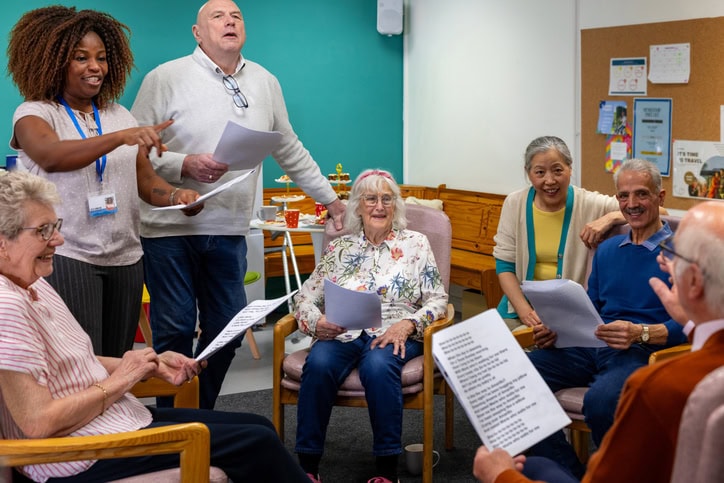
Photo: SolStock/E+ Collection via Getty Images
The Lesson You Carry Back
There is a final lesson, and it follows you back into every other teaching space you inhabit. Most of our teaching lives are organized around the future: preparing for the concert, building toward the assessment, developing the student toward some later competence. In a room with people living with dementia, the future thins out, and you are left with the radical act of being fully in the present measure. No one is preparing for next year’s audition. Everyone is here, now, in this song.
Every music classroom needs regular doses of this medicine. Play one piece this semester with no performance goal attached. Sing one song simply because singing it together is good. Watch what it does to your students’ relationship with music when the point is the making rather than the proving.
Parker Palmer writes that vocation is discovered where our deep gladness meets the world’s deep need (Palmer, 2000). There is a particular gladness available in these rooms that the achievement economy cannot offer: witnessing a person, exactly as they are, met exactly where they are, through a song. We are living through an age of profound loneliness among older adults, and while music educators cannot solve it, we can refuse to look away from it. We can bring our craft to the places where presence matters more than polish, and let those places recalibrate our craft in return.
Final Cadence
The song remembers what the mind cannot always hold, and in the singing, for a little while, so do we. Teach as if the person in front of you is the whole point, because in that room, finally and truly, they are. That is not a lesser pedagogy. It might be the truest one we have. And when you carry it back to your classroom, your studio, your ensemble, you will find that presence was never the absence of rigor. It was rigor aimed at the right target all along.
References
- Kitwood, T. (1997). Dementia reconsidered: The person comes first. Open University Press.
- Music and Memory. (n.d.). About us.
- Palmer, P. J. (2000). Let your life speak: Listening for the voice of vocation. Jossey-Bass.
- Rossato-Bennett, M. (Director). (2014). Alive Inside: A Story of Music and Memory [Film]. Projector Media.
- van der Steen, J. T., Smaling, H. J. A., van der Wouden, J. C., Bruinsma, M. S., Scholten, R. J. P. M., & Vink, A. C. (2018). Music-based therapeutic interventions for people with dementia. Cochrane Database of Systematic Reviews, (7), CD003477. doi: 10.1002/14651858.CD003477.pub4
- van der Steen, J. T., van der Wouden, J. C., Methley, A. M., Smaling, H. J. A., Vink, A. C., & Bruinsma, M. S. (2025). Music-based therapeutic interventions for people with dementia. Cochrane Database of Systematic Reviews, (3), CD003477. doi: 10.1002/14651858.CD003477.pub5
About the Author
 NAfME member Dr. José Valentino Ruiz is a multi-Latin GRAMMY®-winning and multi-Global Music® Award-winning bassist, multi-instrumentalist, composer, producer, and educator. He is an Associate Professor and Founder/Coordinator of Music Business & Entrepreneurship at the University of Florida, a U.S. Department of State U.S. Speaker on Creative Economy and Global Arts Entrepreneurship, and an internationally active recording and performing artist. Ruiz also serves in editorial, research, and interdisciplinary leadership roles spanning music, creative industries, entrepreneurship, artificial intelligence, healthcare, and cultural diplomacy.
Did this blog spur new ideas for your music program? Share them on Connect! Interested in reprinting this article? Please review the reprint guidelines.
The National Association for Music Education (NAfME) provides a number of forums for the sharing of information and opinion, including blogs and postings on our website, articles and columns in our magazines and journals, and postings to our Connect member portal. Unless specifically noted, the views expressed in these media do not necessarily represent the policy or views of the Association, its officers, or its employees.